Merchant Kings has looked like a prototype since the day I put it up. Coloured hexes, a sidebar, some icons I drew myself in an afternoon. It played fine and it looked like what it was. It does not look like that any more. The whole game is pixel art now, drawn on purpose, by somebody who knows what they are doing. This post is what changed, what it means for your worlds, and the three things I got wrong on the way.
The new look reaches every world, old and new, the moment you load it. None of it is stored in your world. It is all drawn on your screen, so a world you started in August gets the same treatment as one you start today. Nothing in your game moves, nothing resets, your cities are where you left them. The ruleset changes further down are different. A world keeps the ruleset it was born with, for life. Those changes are ruleset 39, so they apply to worlds created from today onward. If you are playing on 38 or earlier, your world plays exactly as it did yesterday. It just looks better.
The map
Terrain is drawn now instead of coloured in. Savanna, sahel, jungle, desert and the rest each have their own ground, and where two of them meet, the edge actually reads as an edge rather than a line between two shades. Trees, scrub and rocks sit on the ground rather than being the ground.

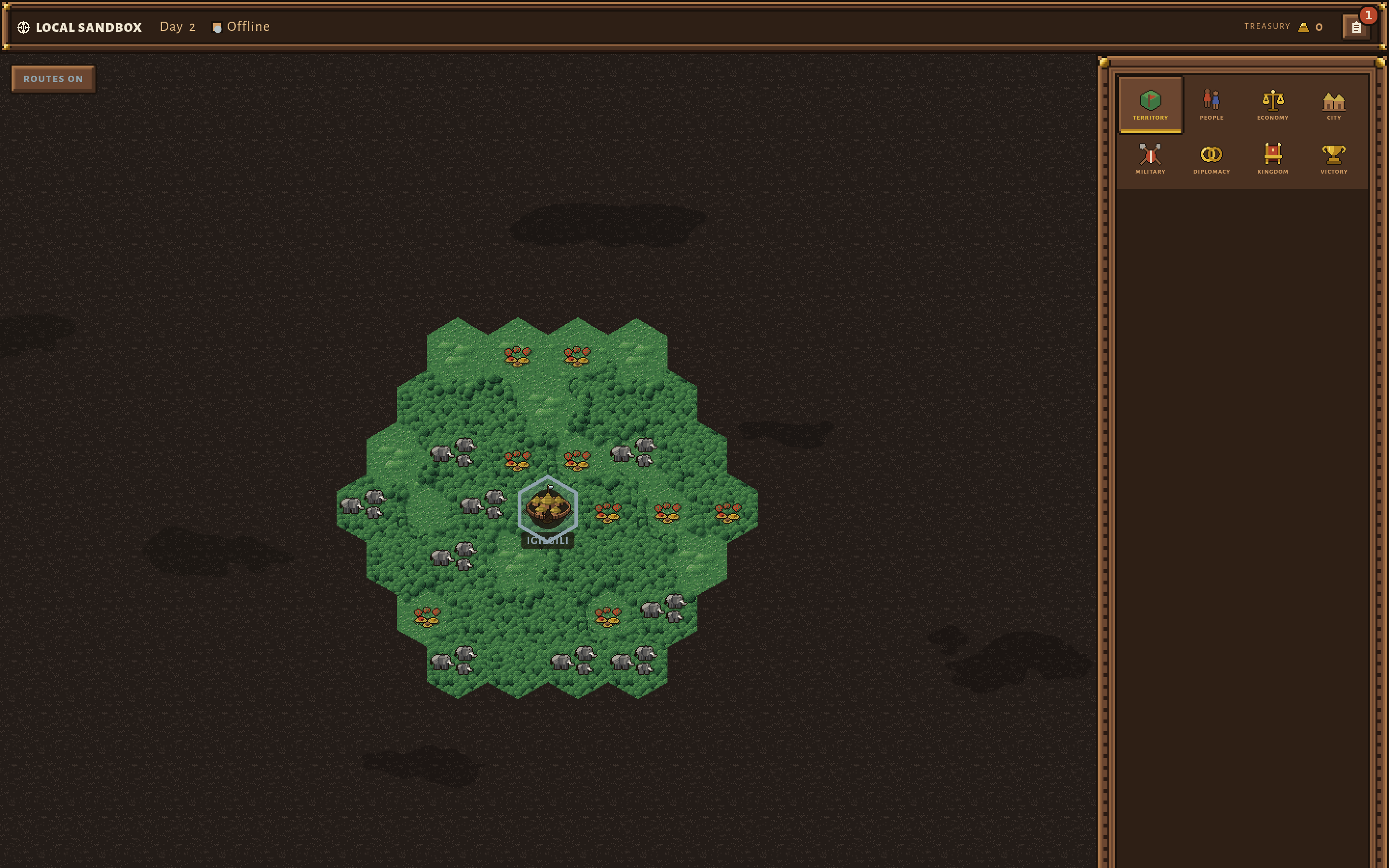
Your settlements change as your kingdom does. A stone age capital is a cluster of huts behind a palisade. An imperial one is a different thing entirely, in stone, and you can see which is which across the map without clicking anything. Armies have a marching step. Cloud shadows drift across the world.
Luxury deposits are visible on the ground now, which is the part I like most. A seam of gold, an ambling elephant, a stand of spice trees. You only see them on land you have explored, and once you have seen one it stays on your map, the same way the rest of your map memory already works.
The panels
Every panel in the game is new. Carved wood, brass edges, proper frames on the buttons and the input boxes. The tabs down the side, the build cards, the stockpile rows, the diplomacy list, the research tree, all of it.

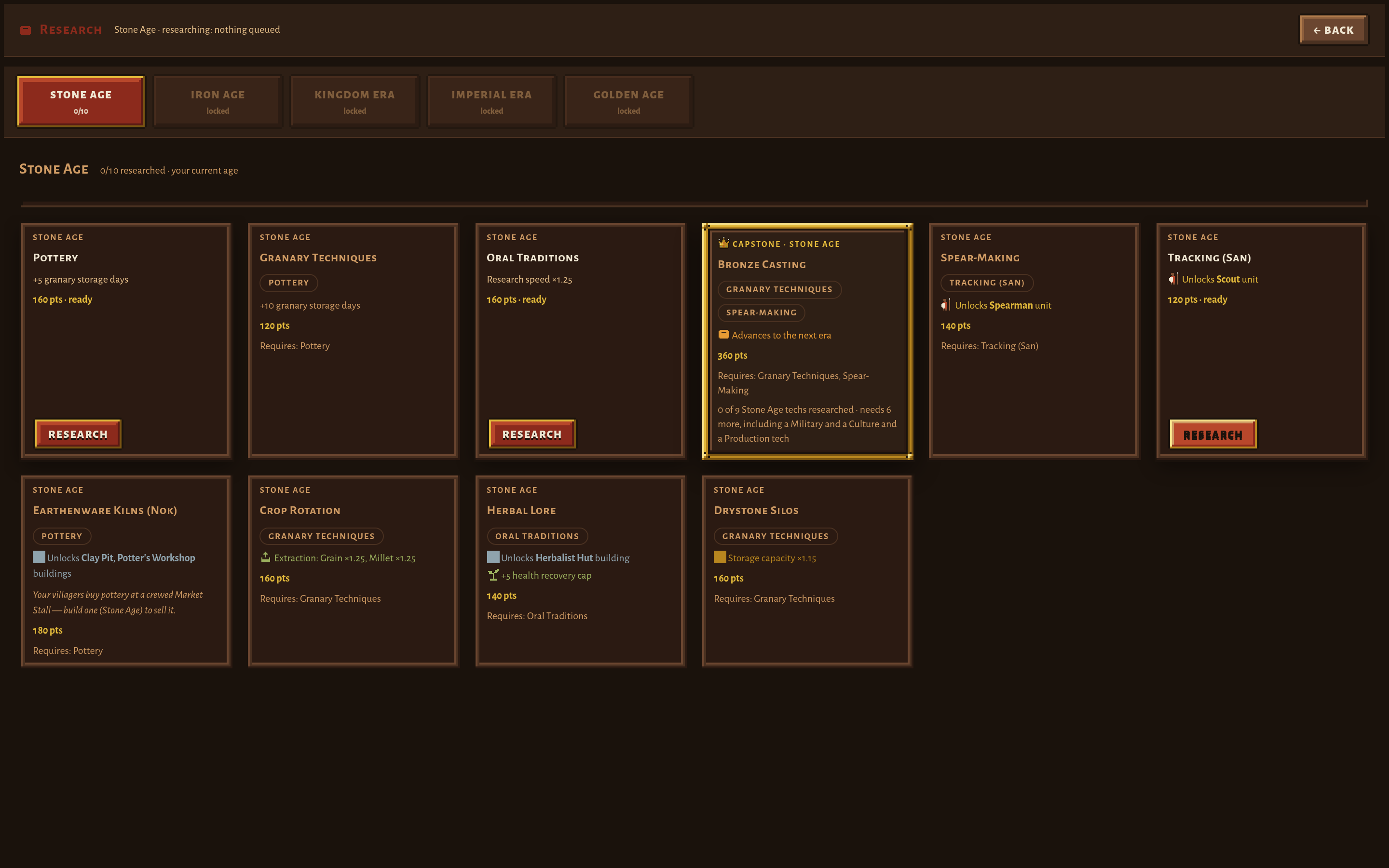
Nothing moved. Everything is where you already know it is, wearing something better.
Your cities have people in them
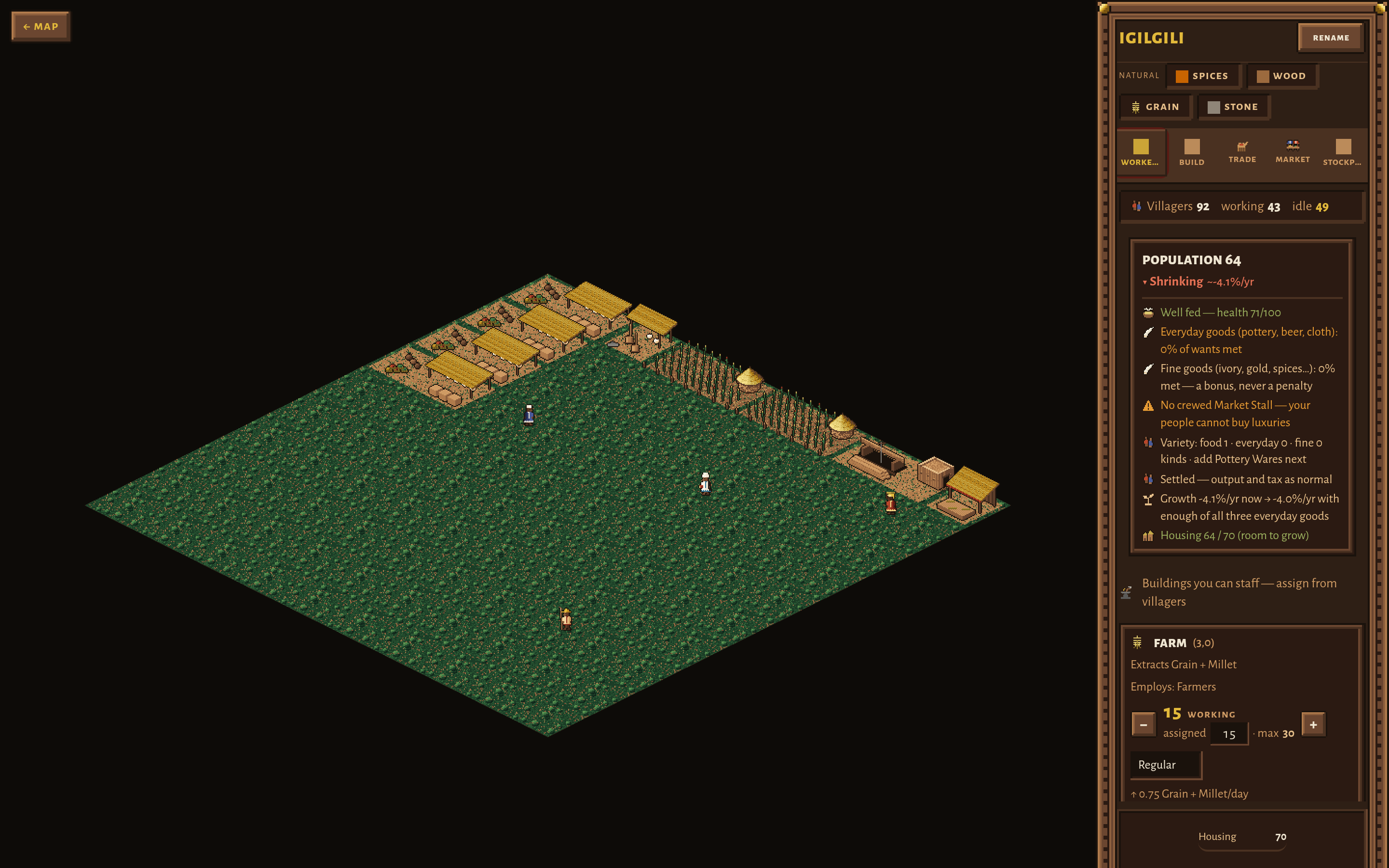
Small thing, big difference. There are townsfolk walking around your cities now, on paths that keep them out of your buildings. The ground under your city matches where you built it, so a desert city sits on sand and a savanna city on grass, and if your hex has a river running through it, the river runs through your city too.
Ruleset 39: deposits are rare now
Here is the change you will feel most, and it only applies to worlds born from today.
Luxury deposits were far too common. On a 38 world, something sat on about one land hex in four. In the Sahara it was more than half the map, and in jungle nearly half. That is not a resource you go looking for, that is wallpaper. It also buried the new artwork, which is what made me finally look at the numbers.
On ruleset 39, a deposit sits on roughly one land hex in sixteen. You will not find two of the same kind side by side. And each one only turns up where it belongs: ivory where elephants would actually be, gold in the right rock and never on the coast, camels and spices in their own country.
So finding one matters now. Siting a city to take in a gold seam is a real decision instead of a shrug. If you have been playing on 38 and you start a new world today, the map will feel emptier at first glance. That is deliberate. What is on it is worth something.
I changed nothing about the ordinary raw materials. Wood, stone, iron, cattle, grain, millet and salt are exactly where they always were, at exactly the rate they always were. Those are what your economy actually runs on and I did not want to touch them while changing something else.
Ruleset 39: the palisade, and a gate
The Palisade Wall took up two tiles of your city grid. On 39 it takes one, which is what it should always have been, and it means a wall costs you less of the room you were saving for a workshop.
There is also a new building: the Palisade Gate. One tile, stone age, six wood and four days, cheaper and quicker than a length of wall because a gate is one braced opening rather than a run of stakes. It gives no defence bonus, and that is on purpose. A gate is the hole in your wall. Paying you a bonus for building one would make a wall with a gate in it better than a solid wall, which is nonsense.
An existing palisade in a world you already play does not change shape. It was built under the rules it was built under and it stays that way.
The game asks for less when you come back
A small technical thing with a real effect. All this artwork is a lot of files, and every single time you opened the game, your browser asked my server about every one of them, just to be told nothing had changed. Fifty-two questions before you could play.
Now each image carries a name based on what is in it. If an image changes it gets a new name, so your browser knows without asking that the one it already has is still good. Opening the game a second time went from 159 questions to 108, and only one of those is about artwork.
This does not save you any download. You were not re-downloading the pictures before. What it saves is the waiting, and on a phone on a bad connection the waiting is most of it.
What I broke on the way
Three, and they are all mine.
The crown that was not there. Eleven places in the game ask for a little crown icon: the message when somebody is crowned, the victory panel, the end of the world screen, the world list. Nobody ever drew that crown. For weeks every one of those spots drew a small empty gap, and I never noticed, and neither did anyone else, because of how it was missing. The game builds that icon's name out of pieces while it runs, so searching my own code for the crown turned up nothing at all and looked like proof there was no problem. The one test whose entire job is catching missing artwork could not see it for the same reason. Two separate safety nets, one blind spot. There is a real crown now, and that test has been taught to see through the trick.

I was showing you the art at half size. The artwork was drawn for map tiles twice the size of the ones I was drawing them into, so for weeks every tree, building and elephant on your map was being shrunk by half before it reached your screen. It still looked decent, which is why it took me so long to catch. It looks considerably better at the size it was painted.
The victory banner sat on top of your tabs. When a kingdom gets close to winning, a strip appears across the top of the screen. For about three weeks that strip was covering the top of the sidebar on desktop, including the row of tabs you click to switch panels. The tabs still worked, it was only sitting over them, but it looked broken and it was. This one is embarrassing because I had already fixed it once, back in August, and I fixed it by writing down a number instead of working it out. Then the toolbar got taller and the number did not.
That last one taught me something I have since gone and applied in about eight other places: a test that copies a number out of the thing it is testing is not testing anything.
Known issues, still open, still mine
- The fallback map has no rivers. Some devices cannot run the good renderer and get a simpler one. That simpler map has never drawn rivers, at any zoom, and it still does not. It is not a thing I broke this time, it is a thing that was never built, and I have not decided yet whether to build it.
- The tutorial has not been reshot. It still walks you through screens that look like the old ones in places.
What it means for you
Load the game. That is it. The new look is already there, in whatever world you are playing, and you do not have to do anything.
If you want the ruleset 39 changes, the rarer deposits and the one-tile palisade, start a new world. Your existing ones keep their own rules, as always.
And if the map feels empty when you start that new world, give it a few days. Finding a gold seam is supposed to feel like finding something.
Peace,
Yadah