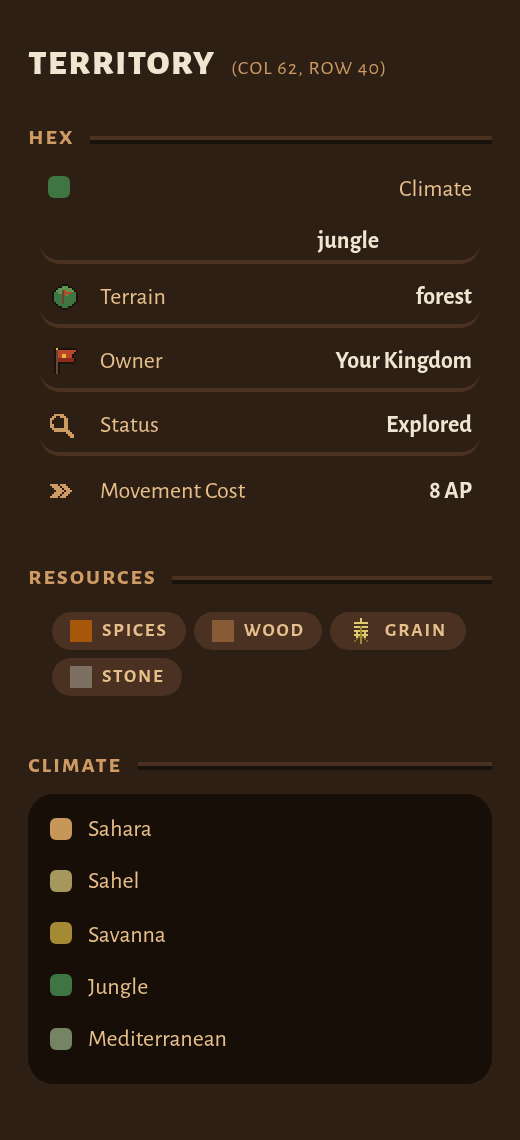
1Why is my Diplomacy tab empty?
Because you have not met anybody yet. When it says "You have not met any other kingdoms yet — explore to find your neighbours", that is exactly what it means. Nobody has died. There are almost certainly several other rulers out there.
You meet a kingdom the first time one of these happens: you see a tile they own, you see one of their armies, or they get in touch with you first — an offer arrives at your court, or you end up party to a treaty with them. From that moment they are on your list and they stay on it. You will not un-meet somebody by losing sight of them.
The practical upshot is that diplomacy starts with walking. March a scout or a small army out into the dark, or settle towards the edge of what you can see, and the names will arrive. Until they do there is nobody to talk to, and no amount of staring at the tab will change that.
2What the table shows you
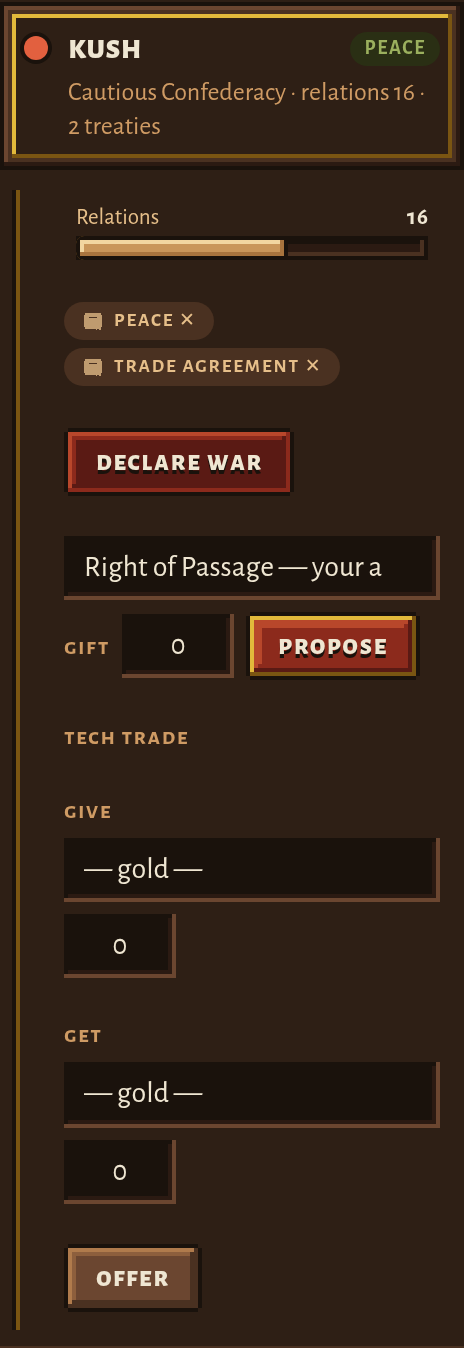
Open the Diplomacy tab in the side panel. It does not care which hex you have selected — this is your whole kingdom's business, not one city's.
Each ruler you have met gets a row: their colour, their name, one word for where you stand with them (At war, Your vassal, Your overlord, Peace or Neutral), the kind of ruler they are, and a relations number. Click a row to open it. Inside you get a bar for relations, a chip for every treaty the two of you have signed, and the controls for offering a new one.
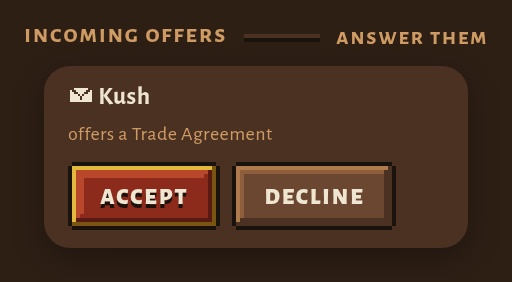
Anything they have sent you sits at the top under Incoming Offers, with an Accept and a Decline button. Those stay there until you answer them, even if the kingdom that sent them is nowhere in sight.
3The six things you can offer
Pick a treaty from the dropdown in a rival's row, put a number in the Gift box if you want to sweeten it, and press Propose. Against a computer ruler you get an answer straight away. Against another player it sits in their Incoming Offers until they read it.
| Treaty | What it actually does | How hard to get |
|---|---|---|
| Peace | Your armies stop fighting theirs. The single most useful thing on this list. | Easy |
| Trade Agreement | Removes the toll your caravans pay crossing their land. Does not stop the fighting. | Easy |
| Research Pact | Each of you gains a fifth of the other's research, every day. Up to two partners count. | Moderate |
| Right of Passage | You ask to cross their land. Once they agree, your armies may cross it without besieging it, and move a quarter faster while they do. | Hard |
| Alliance | Peace, plus they are dragged in when somebody attacks you. | Hard |
| Vassalage | They swear to you and pay tribute. Worth more points than anything else you can do. | Strength |
Two of those deserve a warning each.
A Trade Agreement is not peace. It means you do business, nothing more. Two kingdoms with a Trade Agreement and no Peace can and will fight each other while their caravans keep running. If you want the shooting to stop, you need Peace, an Alliance or Vassalage — those three are the only ones that suppress it.
Right of Passage runs one way. Whoever proposes it is asking to cross; whoever accepts it is granting passage through their own land. Propose it and you are asking to walk your armies through their country — it does not let their armies into yours. Accept one that arrives for you and it is the other way round: you are opening your border to them. A signed one says which way it runs on its chip — you cross theirs, or they cross yours. That is why it is the hardest ordinary treaty to get: you are asking a ruler to open his door to an army, and computer rulers weigh it accordingly.
Trade tolls are the quiet one people miss. Without a Trade Agreement (or an Alliance, or vassalage) every foreign hex your caravans cross adds friction to the run. The trade guide covers what that does to a long route — on a corridor across two neighbours it is worth more than most wars.
4What "relations" really is
Every pair of kingdoms has a number between -100 and +100. It is not a mood. It is a slow-moving average that drifts, a little each day, towards whatever your treaties say it should be.
Each treaty type has a resting point. Peace pulls you towards 15, a Trade Agreement towards 10, a Research Pact towards 12, Vassalage towards 30, an Alliance towards 40. War pulls you all the way down towards -60. With no treaty at all, the number drifts back towards zero and stops caring about your history.
The drift is about two per cent of the gap each day, which is deliberately slow. Sign an alliance and you do not wake up on 40 — you climb towards it over a season. The same slowness works in your favour after a quarrel: an insult fades on its own if you leave it alone.
On top of the drift, things happen. Signing a treaty gives an immediate bump — a Peace is worth 10 on the day, an Alliance 20. Breaking one costs 30. Attacking somebody costs 25, and it also costs you 25 with every ally of theirs. Declaring a formal war costs 40 on top of whatever the broken treaties cost.
Gold in the Gift box helps an offer along: roughly every 50 gold buys one point of goodwill in the decision. It stops counting at twenty points, so a gift above about 1,000 gold is wasted — the extra buys you nothing at all. And the gold only changes hands if they accept.
5Will they say yes?
A computer ruler decides with a sum, not a mood, and the sum is simple enough to plan around. They add your relations, the points your gift bought, and a small adjustment for the treaty itself, then check it against that treaty's bar.
Peace has a bar of zero — as long as you are not actually hostile, it usually goes through. A Trade Agreement needs 10 and comes with a +10 nudge in its own favour, because it plainly suits both of you, so it is nearly as easy. A Research Pact is much the same at 25. Right of Passage needs 30 and carries a -20 penalty for being risky, which means you effectively need relations near 50 before anyone opens their border. An Alliance needs 50 flat.
So the sequence that works is the obvious one, done patiently. Peace first. Let it drift. Trade next. Let that drift too. By the time you ask for passage or an alliance the number has climbed on its own and the answer is yes.
If they say no, it costs you 5 points — except for a declined peace offer, which costs nothing, so there is never a reason not to ask for peace. A refusal is also remembered: a computer ruler will not put that same treaty back on your table for about ninety days.
6Peace is not the default
This is the rule that surprises new players most, so read it twice.
Two kingdoms with no treaty between them are already able to fight. There is no peaceful default state you have to be dragged out of. March an army onto a neutral neighbour's city tomorrow and it simply happens — no declaration, no warning, nothing to sign first. The game will put a confirmation box in front of you, and that box is the only thing standing between you and a war.
Peace is a thing you go and get. Until you have it, every neighbour you have met is a neighbour who can walk in.
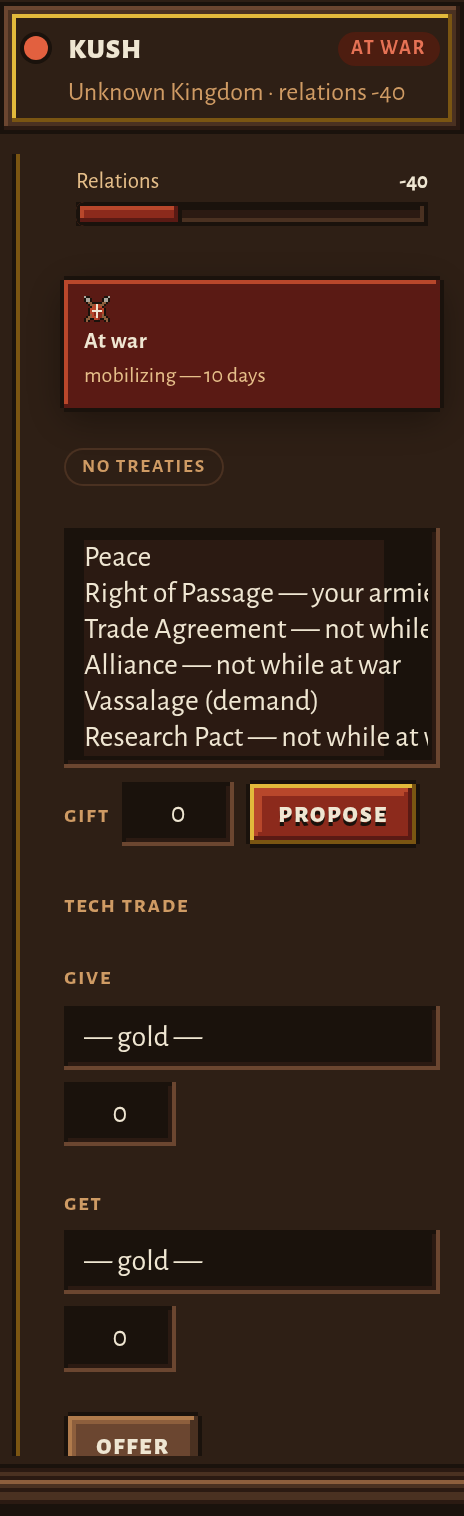
There is also a formal war — a declared state, shown as a red At war box on that ruler's row. A computer ruler can declare one on you, and you can declare one yourself: open a rival's row and press the red Declare war button. It is not there while the two of you are already at war. Before anything happens, a box asks you to confirm and names every treaty the declaration will tear up, because a declaration wipes out every treaty between the pair at once. That is why a betrayal is so expensive for the betrayer: they lose 30 for each pact on top of the 40 for declaring.
You never need to declare war to attack a neighbour you have no treaty with. What a declaration changes is that the fight is now out in the open. Relations sink towards -60 and stay there. And a computer ruler you declare on treats it exactly as if it had declared on you: ten days to gather itself, then its armies are free to come for your cities and your caravans. Declare only when you are ready for that.
Fighting has a cost you will not see on the diplomacy tab at all. For twenty days after a battle, deliveries between the two of you stop — routes suspended, contracts dormant. They come back on their own if the fighting stops. Raid a trading partner and you have shut your own corridor as surely as theirs.
7Getting out of a war
You cannot simply cancel a war. There is no Break button on a war — that would make declaring one free, and it is not meant to be.
There are exactly two ways out. Sign a peace, or submit as a vassal. Either one supersedes the war and the fighting stops. Everything else you might want to sign — trade, passage, even a full alliance — is refused while a war stands between you.
Peace is harder mid-war than it looks, because the war itself has dragged your relations down to about -60 and pinned them there. What breaks the pin is time. The longer a war runs, the more tired of it the other side becomes, and that weariness is added to their decision when you offer peace. A ruler who is fresh, or winning, will refuse you. Keep offering. A long grinding war eventually ends because somebody wants it to.
Which is worth knowing before you start one. There is no quick exit. Going in is one click; coming out takes as long as the other side needs.
8Vassals, and why they matter so much
A vassal is a lesser kingdom that has sworn to you. They keep their cities and run their own affairs, but they stop being a threat, their armies pass through your land freely, and every thirty days a fifth of their treasury arrives in yours.
That tribute is pleasant. It is not the reason to want one. The reason is that a vassal paying tribute is worth an enormous number of victory points — more than a season of conquest, for the price of one conversation. The road to victory guide lays out the arithmetic, and it is the single most commonly missed thing in the game.
Vassalage is the one treaty that does not go by relations. Choose Vassalage (demand) and the answer comes down to strength: a computer ruler submits if they are less than half as strong as you, or if they adore you outright at 80 or more. That makes it the natural finish to a war you were winning anyway — beat a neighbour down, then demand submission rather than grinding out ten more days of siege. You get a paying subject instead of a ruin.
Two rules keep the system honest. A kingdom can serve only one overlord — nobody is claimed twice. And the chain cannot loop: your own overlord can never end up swearing to you.
If you are chasing the combined-score path to victory, only the kingdoms who answer directly to you count towards your total. Your vassal's own subjects are his business. Three lords sworn to you beat one lord with a long tail behind him.
If you take one habit away from this guide, take this one. Every time you meet somebody new, offer peace that same day. It is nearly always accepted, it costs you nothing if it is refused, and it starts the slow climb that every other treaty is waiting on. The rulers who end up wearing the crown are rarely the ones with the biggest armies — they are the ones who spent the early years making sure nobody had a reason to come for them.