1Found in the right place
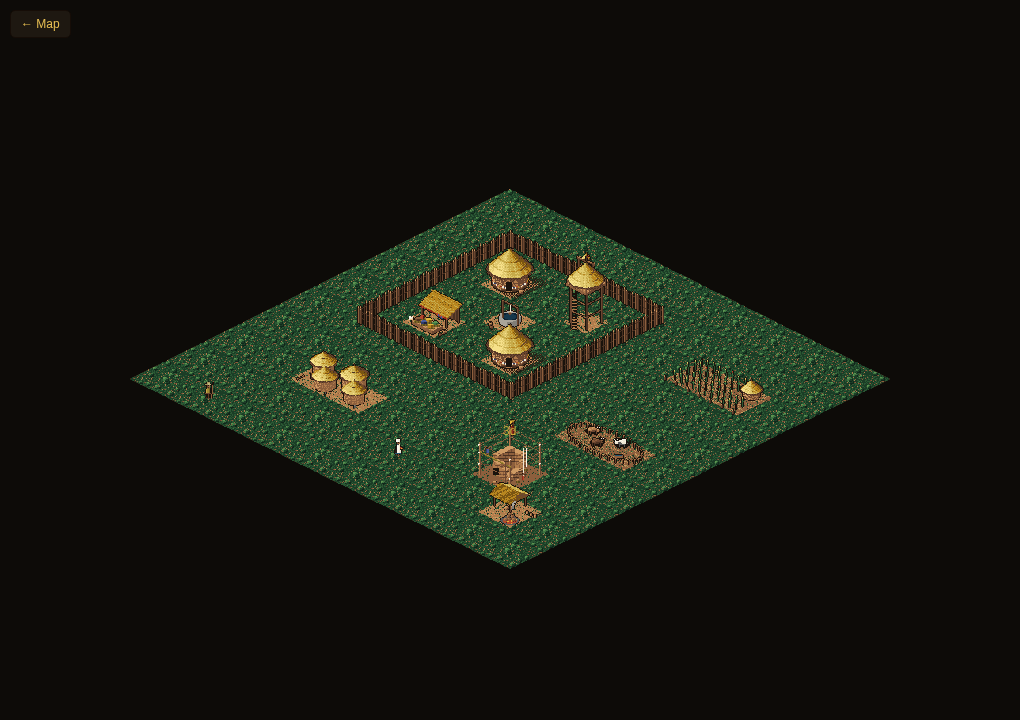
Your first tile is the one decision you cannot walk back cheaply. The game will let you place a capital almost anywhere, and the difference between a good site and a bad one does not show up until day forty — by which point moving is no longer an option.
Look for three things, in this order: a tile with a food deposit adjacent, a second deposit of any material within a short march, and a position that sits between two other kingdoms rather than in a corner. The corner feels safe. The corner has nobody to sell to.
2Housing comes before everything
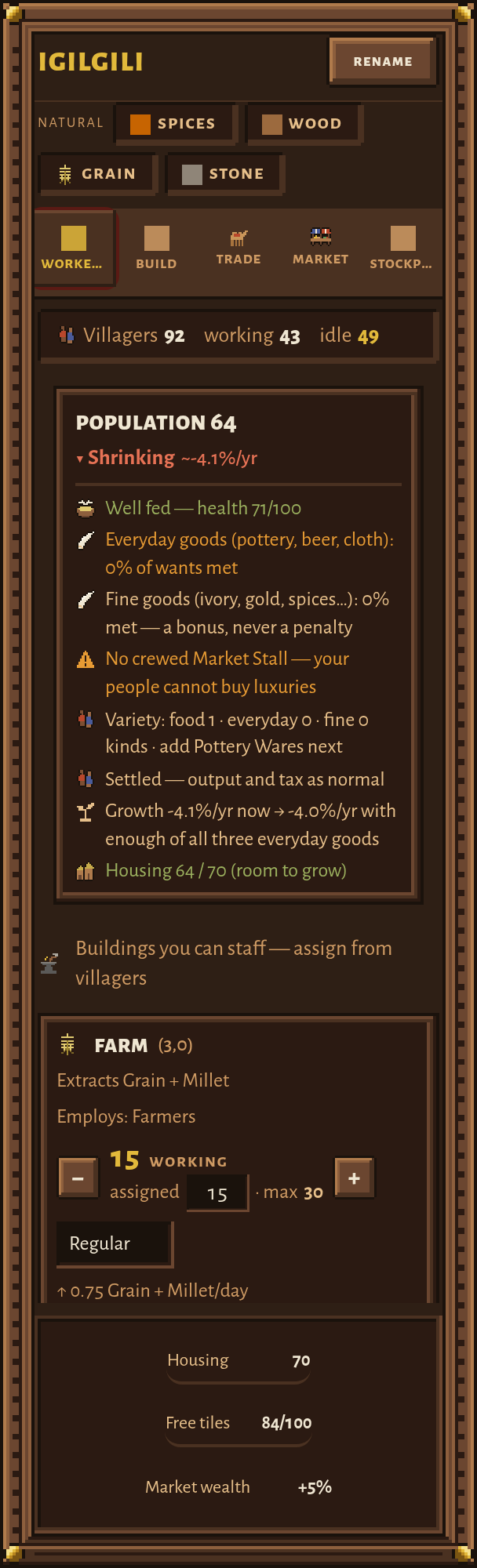
Every unit of everything in this game is produced by a real person standing in a real building. People need housing, and housing is thatched huts — five wood, three days, ten population capacity each. Until you have housing headroom, nothing else you build matters, because there is nobody to staff it.
The counter to watch sits pinned at the foot of the city view: housing used against housing available. Keep at least ten of headroom at all times in the first hundred days. A city at its housing cap stops growing silently — no warning, no toast, just a population number that never moves again.
3Staff the farms yourself
Idle villagers do not walk into empty farm slots on their own. This is the single most common way a new capital dies, and it dies quietly: production looks fine on day thirty because the granary is still draining.
Staff the farms by hand and watch the days-of-food figure on the City tab. People start work the same day you assign them, so the only reason a row shows fewer working than you asked for is that you have run out of idle villagers to send. If those two numbers disagree, the order took — you simply have nobody left to fill it.
An untouched capital tends to run its food to zero around day ninety, because idle villagers never fill empty farm slots by themselves. Then it starts to shrink, and it keeps losing people until its farms can feed the ones who are left. This is a live bug, not a difficulty setting. Staffing the farms by hand avoids it entirely, but you do have to do it.
4The only two numbers that matter
Ignore almost everything on the panel for your first hundred days. Two figures decide whether you have a kingdom at all: days of food, and housing headroom. The target for the second is the same the whole way through — ten spare.
| Days | What you are doing | Days of food |
|---|---|---|
| 1–10 | Two huts, one farm, staff the farm to its maximum | 20+ |
| 10–30 | Granary, well, second farm, first storage area | 30+ |
| 30–60 | Claim two more hexes; market stall; first material building | 40+ |
| 60–100 | Settler party for a second city; one export route | 50+ |
5Storage will betray you
Storage is capped per resource and perishable goods spoil. A warehouse jammed with something nobody in range will buy is not a reserve — it is a slow bleed that also blocks the space you need for grain.
Since ruleset 29 the Stockpile tab carries a Discard control on every resource. Use it without sentiment. Throwing away forty units of a material you cannot sell is cheaper than losing forty units of food to a full store.
6Your first caravan route
A route takes four things: the resource, the daily volume, the reserve your origin city keeps for itself, and how many units ride with it. The reserve is the one people skip, and skipping it is how a generous player starves their own capital feeding an ally.
Grain · 2.00 a day · keep ≥ 40 at home · two spearmen riding. The route ships only what sits above forty, guards cost half upkeep while posted, and the shield on the map tells a raider they will have to fight for it.
7Found a second city
Your kingdom will not spread on its own. Nothing creeps into the next valley while you are looking the other way, and nobody will suggest it to you. If you want a second city, you have to go and gather a party of settlers and send them out. Most first kingdoms are still sitting on the one tile at day two hundred simply because their king was never told that.
You do it from the Military tab of a city that has people to spare. The party costs 20 gold and takes eight days to gather, and the settlers come out of your idle villagers — this is the one job that pool is genuinely for. Load them up before they go: each settler can carry five loads, and food is what you want, because a new settlement starts with nothing and has to eat while it clears its first field.
When they are ready they appear as a small army. March them to an empty hex nobody has claimed, and choose Settle. Pick the spot the way you picked your capital — food next door, and close enough that a caravan can reach it.
The game will not let you starve your own city to found another one. It works out how many hands your farms need to keep everyone fed, and it will not let you take settlers past that line. So if the option is refused, it is telling you something useful: your capital is running closer to the edge than you thought. Put more people on a farm, let the granary build back up, and come back to it.
Somewhere between day sixty and day one hundred is the right moment. Go earlier and you are pulling hands off the farms keeping your capital alive. Leave it much later and your neighbours will have taken the good ground.
8What to ignore for now
Price ceilings, market operations against rival cities, and most of the tech tree can all wait. Diplomacy cannot wait quite as long — you only see kingdoms you have actually met, and meeting them early gives you somewhere to sell.
Research is worth a little of your attention, though, because from ruleset 33 it is paced. A city with no knowledge building holds five productive scholars — assigning more just empties your farms. Five is plenty for now: the Research window opens once your villagers' intelligence reaches eighty, which five scholars in a young capital manage in about ten days, and the Stone Age costs are the lowest you will ever see. Queue a technology as soon as the window opens and keep one queued; your banked points are capped at the cost of the dearest technology in your current age, so walking away with nothing queued wastes scholar-days. Leaving the Stone Age needs six of its nine technologies before Bronze Casting will take — the capstone card counts it down for you. The bigger research buildings, goods-consuming techs and deeds all belong to later ages; ignore them until day one hundred.
If you hit something that looks broken, note the game day and what you had just done. That pair is almost always enough to reproduce it.