1What a raid actually does
The trade guide shows you how to open a route. This guide is about the day somebody comes and takes it away from you.
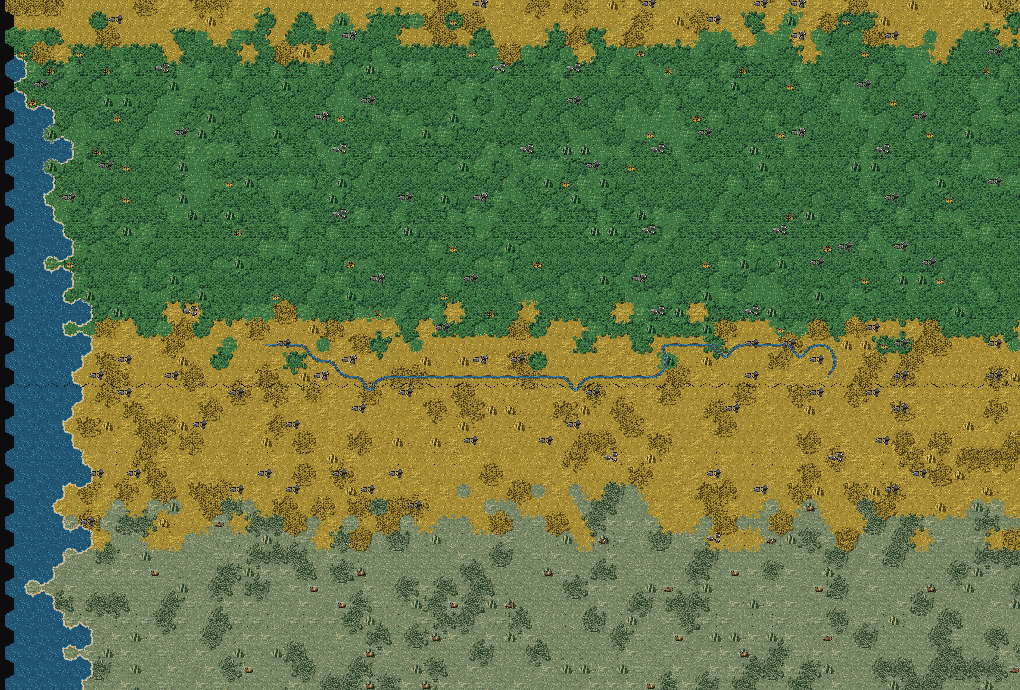
A raid is not a delay and it is not damage. An enemy army standing on your road presses one button and the route stops existing. The card vanishes from Economy › Trade, the dashed line comes off the map, and tomorrow nothing arrives at the far end.
You cannot repair it. You build a new route from scratch, pay the guards again, and hope the same army is not still sitting there. If a colony has been living off a grain route from your capital, a raid is the day that colony starts going hungry — and there is no warning, only a red message naming the route and whoever destroyed it.

2Who is allowed to cut my road?
Almost everybody, and this is the part that surprises people: they do not have to be at war with you. Every kingdom is hostile to every other kingdom by default, and only three treaties turn that off.
| What stands between you | Can they cut your route? |
|---|---|
| Peace | No |
| Alliance | No |
| Vassalage (either direction) | No |
| Trade agreement | Yes |
| Right of passage | Yes |
| Nothing at all — a stranger | Yes |
| War | Yes |
Read the middle of that table twice. A trade agreement is not peace. It means you do business with each other; it does not mean their soldiers will leave your carts alone. Right of passage is worse if you are the one who granted it — you have invited their armies onto your land.
Contracts you buy from a neighbour have an extra rule. The route belongs to the seller, but anyone hostile to you, the buyer, may cut it as well. That is how a rival strangles your imports without touching your borders. You cannot put guards on a contract at all — guards belong to ordinary routes, the ones you created and own outright.
3Where on the road can they do it?
Not anywhere. The road is a fixed line of hexes worked out when you created the route, and only the hexes in the middle count. Both ends are safe: the city the goods leave and the city they arrive at can never be used as a raiding spot.
That has a consequence worth building around. A route between two neighbouring cities has no middle at all, so there is nowhere to stand and nothing to press. It cannot be raided.
Two more things must be true before anyone can touch you. The army has to be standing still — a column still marching cannot raid on the way past. And they have to be able to see the road: a foreign route appears for a kingdom only once their vision reaches some hex along it, which means their land, or their scouts, are near it.
The game picks the cheapest road for you, and cheapest usually means straight. If straight runs through a stranger's land, a route to a slightly different city can put the whole road inside your own borders — where an enemy has to fight its way in before it can stand on it.
4Putting guards on a route
Guards are soldiers who ride with the carts. Add them when you create the route, or at any time afterwards: open Economy › Trade › Routes, find the route's card, and press Edit guards.
The picker asks for the garrison you want, not the change you want. Whatever numbers you leave in the boxes is what the route ends up with — set a type to zero and those soldiers go home.
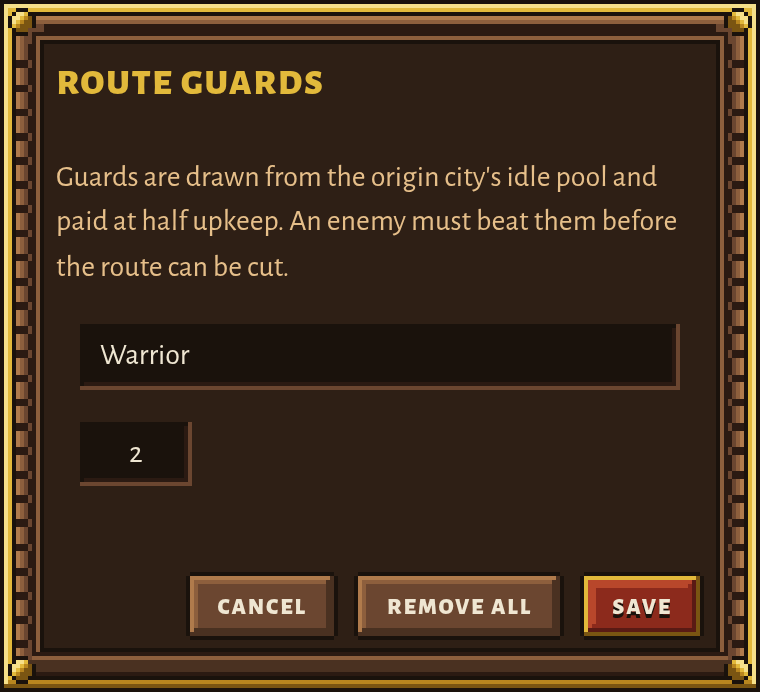
They come out of the sending city and cost what soldiers always cost. Three warriors are 15 gold and 3 wood once, and three of that city's idle people stop being idle. Spearmen, once you have researched them, are 6 gold and 2 wood each and much harder to shift, being built to hold ground rather than take it.
The daily wage is the good news. A guard is paid half what the same soldier costs in the field. A warrior in your army is 0.05 gold a day; the same warrior on a route is 0.025. Three of them come to about 0.08 gold a day.
Two things about guards catch people out. They are not on the map — you cannot march them, they cannot be attacked on their own, and they exist only as part of the route. And they are paid from the same treasury as your armies: if that runs dry they desert exactly as soldiers do, melting away a little each unpaid day. Delete the route yourself and they walk home to the sending city instead, as ordinary people again.
5What happens when the guards are attacked
Without guards there is no fight. The raider presses the button and the route is gone at no cost to them whatever — one lone scout can end a road that feeds a city.
With guards, the raid becomes an ordinary battle, fought where the attacker is standing and resolved the moment they press the button.
| How it ends | Your route | Your guards | Their army |
|---|---|---|---|
| Guards hold | Survives | Some are killed; the rest stay on | Routed — it loses most of what it brought |
| Guards lose | Destroyed | All gone, including any who survived the fighting | Wins, but pays for it |
Two details matter before you decide how many soldiers to post.
A tie goes to the defender. Equal strength on both sides means your guards hold and the route survives. The raider has to be genuinely stronger, not merely equal, and every battle carries a swing of up to a tenth either way — so a raider who is only just ahead is gambling.
Your guards get the home advantage only on your own land. The fight happens on the hex the attacker chose, and defenders draw a terrain and fortification bonus only when that hex belongs to them. A road through your own hills gives your guards the hills. The same road across a stranger's flat ground gives them nothing. That is the strongest argument there is for keeping your trade inside your own borders.
Either way you are told: Your guards repelled Kush (lost 1), or Kush overran your guards — the route is destroyed.

6Cutting somebody else's road
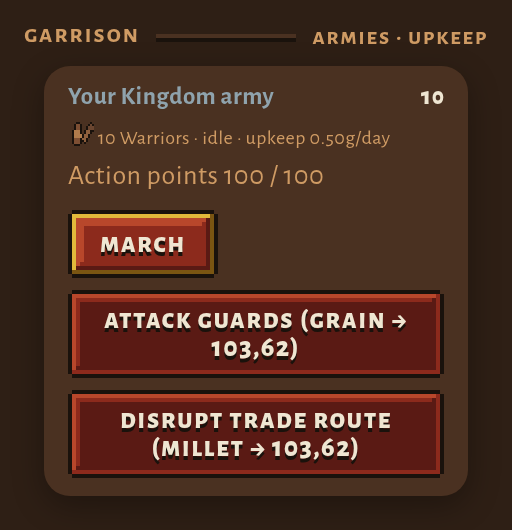
Select one of your armies while it is standing still on a hex a hostile route passes through. In the Military panel, under that army, a red button appears for every route crossing the hex, naming the good being carried and where it is going.
The wording of the button is the only warning you get. Disrupt Trade Route means the road is unguarded and pressing it ends it. Attack guards means there are soldiers on it and you are starting a battle you might lose.
What you are not told is how many guards there are. Your own routes show you the garrison; a rival's shows only that one exists — a small shield on the map where the road runs, with no number beside it. It cuts both ways: your neighbours cannot count your guards either, so two warriors and ten look exactly the same to them until somebody finds out the hard way.
Why bother at all? Because a route is part of a rival's score. A kingdom's standing as a wealthy one is measured partly on how much it trades, so the routes your rivals run are points in their column — see the road to victory guide. Cutting them also takes goods away from wherever they were going, which is often a colony that cannot feed itself.
It is not free. A raid is a battle between kingdoms, so relations with the owner fall and the kingdoms who care about them notice. Cut a stranger's road and you have made an enemy of a stranger.
7What the kingdoms around you will do
The kingdoms run by the game are more disciplined about this than most human players, and knowing their rules tells you when to worry.
They only raid kingdoms they are formally at war with, and not straight away — a fresh war gives them ten days of mobilisation first. A neighbour who merely dislikes you will not touch your caravans. So the day war is declared on you is the day to look at your roads, and you have a little over a week to act. The same goes if you press Declare war on one of them: to the kingdom on the other end it is a war like any other, and ten days later your caravans are fair game.
Once mobilised they are thorough. Any army of theirs already standing on one of your roads cuts every route crossing that hex, and they will detach a single soldier to go hunting for the nearest stretch of road it can reach.
Guards change both behaviours, and this is where the money is. That lone hunting raider will never attack a guarded route — one detached soldier loses that fight, and the game knows it, so guarded roads drop off its list of targets entirely. A standing army will take on a garrison, but only with at least five fighting units to hand. Anything smaller walks past.
So a garrison does not have to beat an empire. It has to make raiding you need a real force rather than a spare man — and a real force is something a kingdom at war would rather point at a city.
They guard their own routes by temperament: a warlike kingdom posts three soldiers on a new route, an expanding one two, a trading one a single token guard. Raid a merchant neighbour and expect one guard. Go after a warlord and bring a column.
8A route worth defending
Not every route deserves soldiers. Spare stone moving between two of your own inland cities can be rebuilt in a minute and nobody wants it. Protect the routes a city would starve without.
If losing this route would hurt a city within a week, put guards on it. Three warriors — 15 gold, 3 wood, and under a tenth of a gold a day — is enough to stop a lone raider outright and enough to make a serious one think. If the road also runs through your own land, those three are fighting on home ground and are worth considerably more than three.
One more way to lose a route has nothing to do with raiding. If the city a route ships from changes hands, the route is destroyed — not paused until you take the city back, destroyed. The guards go with it, because they were the people of a city that is no longer yours. A road is only ever as safe as the city at the near end of it.
If you take one thing away, take this. A route with no guards is not a risk, it is an invitation — anyone who is not formally your friend can end it for nothing, and most of your neighbours are not formally your friends. A few soldiers turn a free kill into a battle, and a battle is a decision. Make them decide.