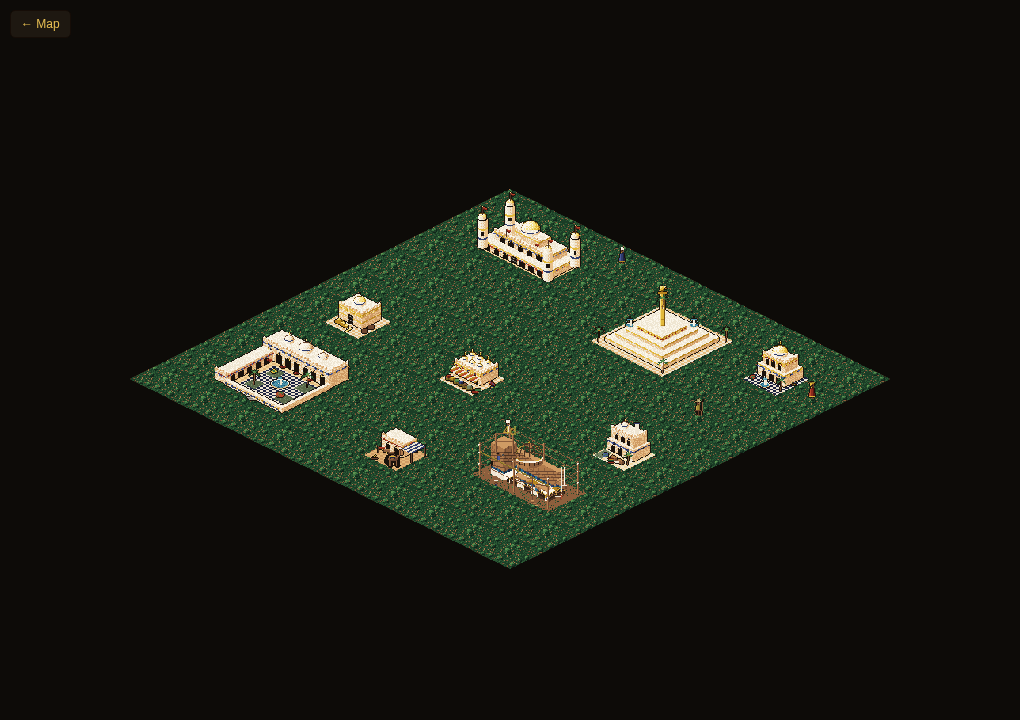
Y'all told me something was wrong, and you were right. Gold, ivory, pottery and cloth never piled up in storage, so the Royal Palace, the Monument and the Great Library, which all want carved ivory, could never be paid for. Neither could the techs that ask for luxuries. The gathering worked and the storage worked. Your villagers were buying every piece the day your workshop made it, because I had them wanting far more than any city could ever make. Ruleset 38 fixes the wanting. Your people now buy a little of every comfort, the more kinds they get the better they live, and whatever they don't buy stays in your stores for the kingdom.
A world keeps the ruleset it was born with, for life. The new wants, the variety and the famine brake are ruleset 38, so they apply to worlds created at 38 or later. If you're on 37 or earlier, nothing changes under you. Promise. A few small things do reach older worlds today, because they change what you see, not how the game plays: the ore called Gold is now Raw Gold, the economy panel lists Consumer Goods, and on a 36 or 37 world a build or research card that's short of a luxury tells you how to save some.
What was actually wrong
When your reports came in, I ran a city that made every luxury in the game, with one crewed Market Stall, for 120 days. Every luxury ended at zero. The same city with no stall kept 60 carved ivory, 45 gold ingots and 45 spices. So the goods were getting made. Your people were buying all of it.
Under 36 and 37 the want was simply too big. A full pottery workshop covered about 15% of what a town of a hundred wanted, and that same town bought every piece a full ivory workshop made and still wanted more. You could never satisfy them, never mind have anything left over. In my longest test world, not one city ended up with a Palace, a Monument or a Great Library. That's on me.
Every comfort is its own want
Now each of the seven comforts is a want of its own. Your people buy a little of every comfort on sale, not just the cheapest. Once they have all the pottery they want, more pots do nothing for them, but a jug of beer does. The more different kinds they get, the better they live and the happier they are.
I sized it so one fully crewed workshop covers about 75 people of average wealth. Richer people want up to twice as much, poorer people down to half. In my test town, sixty people with one full ivory workshop left some over every day. Ninety bought the lot.
Everyday goods (pottery, beer, cloth) still come first, and going without them still hurts. Fine goods are still a bonus that never costs you anything. One honest trade-off: a town living on pottery alone now settles a bit less happy than it did on 37, because pottery is one comfort out of seven now. Add beer and cloth and they're nearly back. Add one fine good and they're past it.
Food counts too
Your people now eat a bit of every food in your stores, as long as they can afford it. They don't eat more, they just mix it up, and a mixed diet counts as variety too. When food runs short, everybody shares the shortage fairly. Nobody goes to the back of the line because of their job.
That fairness had a side effect (more below), so on 38 a city without enough food for everyone loses health faster, and settles near the size its farms can feed instead of growing far past it. It only kicks in when the city is truly short of food. People too poor to buy what's on the shelf keep the old, gentler rate.
Saving up for the palace
Here's the part you asked for. Whatever your villagers don't buy stays in your stores, and so does anything your stalls can't sell. That's what your kingdom builds with: carved ivory for the Royal Palace, the Monument and the Great Library, gold ingots for the Grand Temple, spices for the Grand Bazaar, and luxuries for a handful of later techs and soldiers.
What I didn't do is make it free. One workshop feeding a town of 150 will never leave anything over. To save, you build a real industry: more workshops than your people need, or a small colony with its own workshop and few mouths, shipping the spare to your capital. In a test town of sixty with two ivory workshops, the kingdom saved the 22 carved ivory for a Palace, a Monument, a Great Library and two techs in sixty days, while its villagers bought ivory every single day. One workshop would have saved about 5. Industry takes effort. I think that's how it should feel.
The game tells you where it goes
Open the Stockpile tab and every luxury has a line under it: what the city makes a day, what your villagers want, and who ends up with it, from "they buy all of it" to "the kingdom keeps about" so much a day. The Workers tab has a new Variety line, something like "Variety: food 2 · everyday 1 · fine 0 kinds · add Millet Beer next". And a build or research card that's short of a luxury tells you why (your villagers buy everything you make, your workshop is short of its raw material, or its crew is thin) and what to do about it.
I'm still balancing this
I want to be straight with you. I'm still balancing the economy simulation. The numbers in this post, like how much your people want, how many people a workshop covers and how fast a hungry city declines, come from long test worlds full of AI kingdoms. Not from y'all. Real players do things my tests never think of.
So as I watch real games play out, expect some of these numbers to shift in a later ruleset. Your world keeps the numbers it was born with, so nothing moves under you mid-game. If something feels off, tell me: a comfort you can never make enough of, a building you can never save for, a town that's miserable for no reason you can see. The contact page comes straight to me. I read every message, and this is exactly what I need to hear.
What I broke on the way
Before anything ships I run a five-thousand-day simulated world and read what happened. Ruleset 38 took three goes.
First, I sized the wants so one workshop covered 50 people. Nobody saved a luxury anywhere, and a city with one ivory workshop kept less than it did on 37. So I cut the want by a third.
Second, sharing food fairly broke a brake nobody knew was there. On 37, when food ran short, one group went without, got sick, and the deaths held the city at the size its farms could feed. Grim, but it worked. Share the shortage and nobody got sick enough: one test capital, whose single farm fed 117 people, grew to 171, all of them missing about a third of their meals.
Third, my first fix for that punished poverty too. Farmers with no coin died off with food right there in the store, and in four test worlds out of nine a merchant AI's capital starved out. Now the faster rate only counts when the city truly doesn't have enough food. None of this reached a real world. That's what the long test run is for.
Smaller changes
The ore from a Gold Mine is now called Raw Gold on every world, so it stops getting mixed up with your treasury. Gold Ingots and the Gold Mine keep their names.
The economy side panel now lists Consumer Goods (pottery, beer and cloth) on every world. It had been quietly leaving them out. Sorry about that one.
On a 36 or 37 world, a build or research card that's short of a luxury now suggests taking the crew off your Market Stall for a while, so your people stop buying it and you can save some.
AI kingdoms live by the same wants. They decide when to add a Market Stall from what their people want under the new rules.
What it means for you
| Change | What it means for you |
|---|---|
| Variety | A little of everything beats a lot of one thing. Pottery, then beer, then cloth. |
| Workshops | One full workshop keeps about 75 people supplied. Past that, build another. |
| Saving | To build with ivory or ingots, make more than your people want. A colony with its own workshop is the easy way. |
| Stalls | One stall serves about 130 people when all seven comforts are on sale. Grow past that and add a stall, or a Market. |
| Food | Grow more than one food if your land allows it. Keep your farms staffed: a hungry city shrinks back to what its farms can feed. |
Known issues (still open, still mine)
AI kingdoms don't plan extra workshops yet, so they rarely save luxuries for big buildings of their own. You can. For now that's your edge. I'll teach them.
An AI kingdom sometimes settles a colony that can't feed itself. It starves out, and a while later they settle the same spot again. It did that on 37 too. It's on my list.
The pictures in the Luxuries guide still show the old numbers. The words are up to date, so trust the words. And a few trade and market lines still say "gold" when they mean the ore: if a trade line says you're shipping gold, it's Raw Gold, not your treasury.
Idle villagers still won't fill empty farm slots on their own, so a capital left untouched runs out of food and stays short. On 38 a hungry city shrinks faster, so staff the farms by hand, and early.
The older ones are all still open: AI kingdoms rarely finish a Finite world, kingdoms stay on one tile too long, the AI rarely sells you anything (four devlogs running, I know), and a stall looks the same stocked or sold out. One bright side: a colony is now the easiest way to save luxuries, so you've got a new reason to muster that settler party.
If you hit something else, note the game day and what you'd just done. That pair is almost always enough for me to reproduce it.
Peace,
Yadah