1Why comforts are worth it
Your people need food and will die without it. They also want a few small comforts. Nobody dies without those — but a town that has them works harder and pays more tax.
There are seven comforts, in two kinds. Everyday goods are pottery, millet beer and woven cloth: what ordinary people expect to have. Fine goods are camel gear, spices, carved ivory and gold ingots: a treat. Each comfort is its own want. A town of a hundred people wants about half a crate of each comfort every day, and richer people want up to twice as much. The more different comforts they can buy, the better they live and the happier they are.
Here is what that does to a well-fed town eating a single food:
| What your people are getting | How happy they settle | What the town gives you |
|---|---|---|
| No comforts at all | 70 / 100 | No change |
| Pottery, all they want | 80 / 100 | +5% |
| All three everyday goods | 88 / 100 | +9% |
| All seven comforts | 97 / 100 | +13% |
That bonus is on everything the town makes except food, and on the tax it pays you. It works the other way too: a town whose happiness sinks below 55 is grumbling, and makes and pays up to 15% less. Food is never touched either way.
Two things to know. Happiness moves slowly — about two weeks of game days to get halfway to where it is heading — so give a change time to show. And those figures assume your taxes are paying for the town's upkeep, the Public Works bar on the Kingdom tab. Leave that unpaid and every figure drops, by up to ten.
Comforts still help a town grow, but only a little. The bonus to work and taxes is the real reason to bother.
2No stall, no shopping
Your people only buy comforts at a shop, and the shop needs people working in it. A warehouse full of pottery does nothing if there is nowhere to sell it. No crewed shop, no sales — the goods just sit in store.
Your first shop is the Market Stall. You can build one from day one, with no research, for 3 wood. With three workers in it, it sells up to 4 crates a day. Fewer workers sell less, and an empty stall sells nothing at all.
| The shop | When you get it | Workers | Sells a day, fully crewed |
|---|---|---|---|
| Market Stall | From the start | 3 | 4 |
| Market | Iron Age, with the Marketplaces discovery | 5 | 12 |
| Grand Bazaar | Golden Age, the Market's big upgrade | 8 | 24 |
One stall serves about 130 people when all seven comforts are on sale, and more when fewer are. Grow past that and you need a second stall, or a Market. Every shop also adds a little to the town's daily wealth.
When there is not enough shop to go round, everyday goods are sold first and fine goods get what is left. Nobody jumps the queue: if the stall can only meet half the town's wants, every group of people gets half.
One thing a stall is not for is food. Your people take their bread straight from the store, as always. You never need a stall to eat.
3Each one takes two buildings
Nothing you pull out of the ground pleases anybody on its own. A pile of raw ivory in your warehouse does nothing for a single person in your city — somebody has to carve it first. So every comfort needs two buildings: one to gather the raw material, and one to turn it into the finished thing.
| The comfort | What it is made from, and where that grows | The two buildings you need |
|---|---|---|
| Pottery · everyday | Clay — found everywhere | Clay Pit, then Potter's Workshop |
| Beer · everyday | Millet, which grows in the Sahel | A Farm, then a Brewery |
| Cloth · everyday | Cotton — grows anywhere | Cotton Field, then Weaver's House |
| Camel gear · fine | Camels, from the Sahara | Camel Ranch, then Saddlery |
| Spices · fine | Wild spices, only in jungle | Spice Garden, then Apothecary |
| Carved ivory · fine | Ivory, from savanna and jungle | Hunting Camp, then Artisan Quarter |
| Gold ingots · fine | Raw Gold, from the Sahara and the coast | Gold Mine, then a Mint |
Pottery is the only comfort you can make early, with beer not far behind. The other five belong to a much later age, and four of them — cloth among them — sit behind one discovery, Refined Crafts. For a long stretch of the game, pottery and beer are your everyday goods, and that is enough.
It also takes more hands than you would think. Everybody works at the same steady pace, and a workshop full of potters gets through clay twice as fast as one pit can dig it. So a pottery trade is two clay pits and a workshop, about eighteen people, plus three on the stall. One full workshop covers the wants of about seventy-five people. A town of a hundred and fifty needs two to keep its people supplied, and a third before anything is left over.
4Will your land allow it?
This part decides your plans, and it is not up to you. You can only gather a raw material on ground that actually has it. No ivory in your hills means no carved ivory, however clever your artisans are.
Clay and cotton are the happy exceptions: you can dig clay or plant cotton anywhere you hold. That is lucky, because pottery and cloth are two of the three everyday goods — the ones your people really miss. Nobody can deny you them.
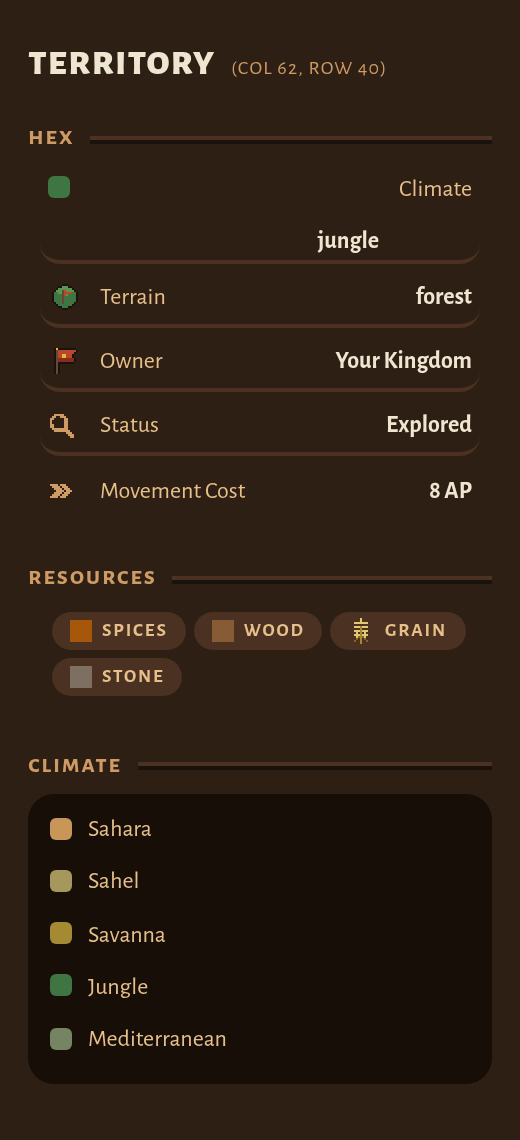
To see what you have, open the Territory tab and look at a hex you own. An empty list is normal: roughly three tiles in ten have nothing at all, and most of the rest have only one thing.
5Everyday first, fine things second
Your people buy their own comforts, with their own money. They buy a little of every comfort on sale, not just the cheapest. Once they have all the pottery they want, more pots do nothing for them, but a jug of beer does.
What they will not do is swap one kind for the other. A gold ingot on the shelf does nothing for a town that has run out of pots. Missing everyday goods is what hurts, so that is where your effort goes first.
So keep your pottery and beer at home. Whatever your people do not buy stays in your stores, and that spare is what your kingdom builds with: a Royal Palace needs carved ivory and a Grand Temple needs gold ingots. Anything your stalls cannot sell stays in your stores too. To build with a luxury, make more than your people want. A small colony with its own workshop is the easiest way: fewer mouths, more left over. Ship the spare to your capital along a supply route.
If the goods are in store and your people still go without, it is one of two things. Either nobody is working the stall, or your people cannot afford what is on the shelf — each group spends at most about half its savings in a day. A poor town next to a stack of gold ingots will never buy one. The answer is cheaper goods, not more of them.
One surprise: brewing loses you money. Two loads of millet make one of beer, and millet is food. Brew because you want your people cheerful and have grain to spare — never for profit.
6If your land says no, buy it
Most kingdoms will never sit on spice country or a gold seam, and that is fine. Open Economy › Browse to see what your neighbours will sell you.
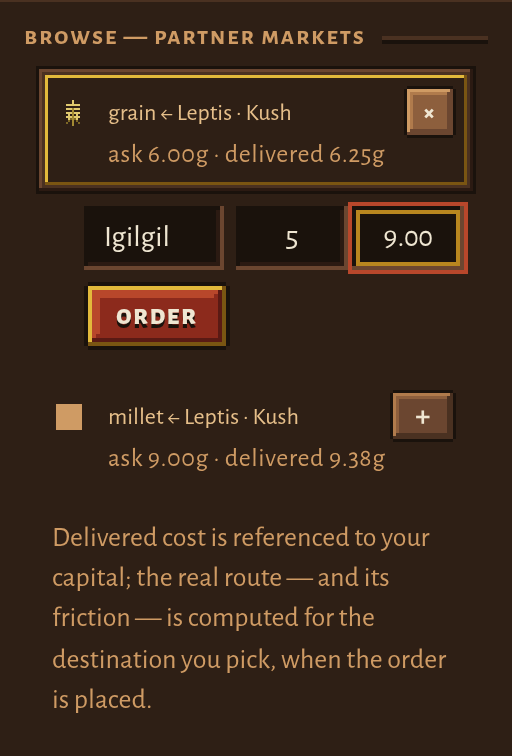
A workshop does not care where its materials came from — only that they are in the city's store. So you can buy raw ivory from a neighbour and carve it at home. Whatever you buy in, it still has to go through your stall.
7Is it working?
Open a city and go to its Workers tab. The card at the top shows, line by line, how your people are doing for comforts.
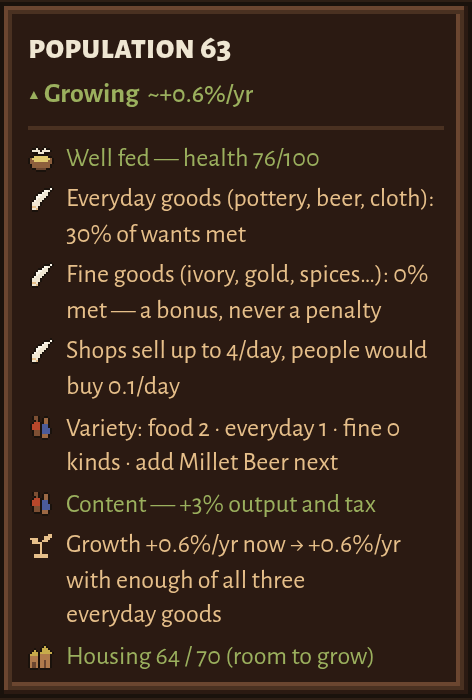
The shop line tells you when the stall is the problem. "No crewed Market Stall" means build one, or put people in the one you have. "Build another Market Stall" means your shops cannot sell as much as your people want. The mood line reads Content with a bonus, Grumbling with a penalty, or Settled when neither applies.
Messages will tell you when a town's stalls start selling, when they sold out with comforts still in store (build another stall), and when a town is grumbling. A town does not grumble just for lack of pottery, though. When you see that one, check its food first.
The People tab tells you who is going without. Your merchants can be perfectly comfortable while your farmers have nothing.
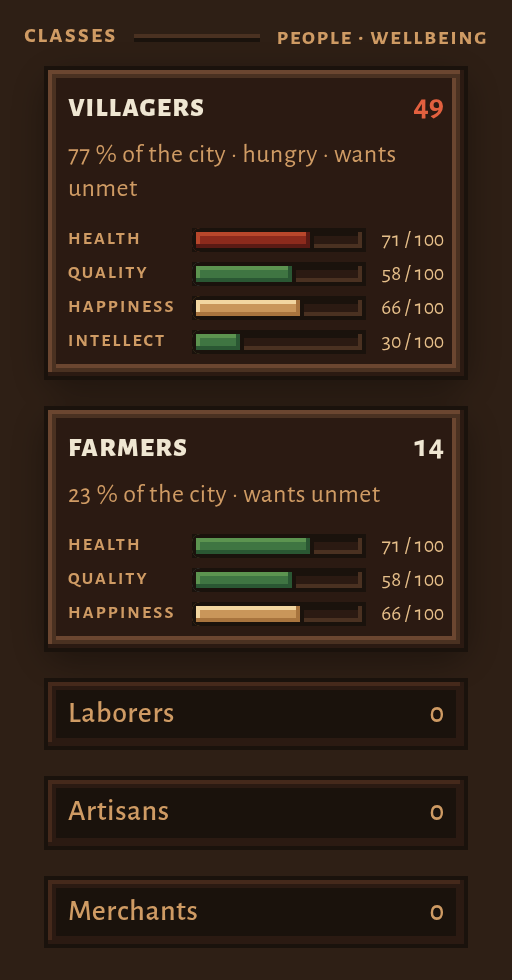
If you want one plan out of all this: put up a Market Stall early and keep three people in it, learn to make pottery, and set two clay pits and a workshop going. A comfort you can make on any ground you own beats one you would have to go to war for.
Playing in an older world? A world keeps the rules it was made with. Before ruleset 38 your people buy every comfort the day it is made, cheapest first, so to save some for building, take the crew off your stall for a while. Before ruleset 36 they need no stall, and a happy town does not work harder or pay more tax.