1What actually happens when you join
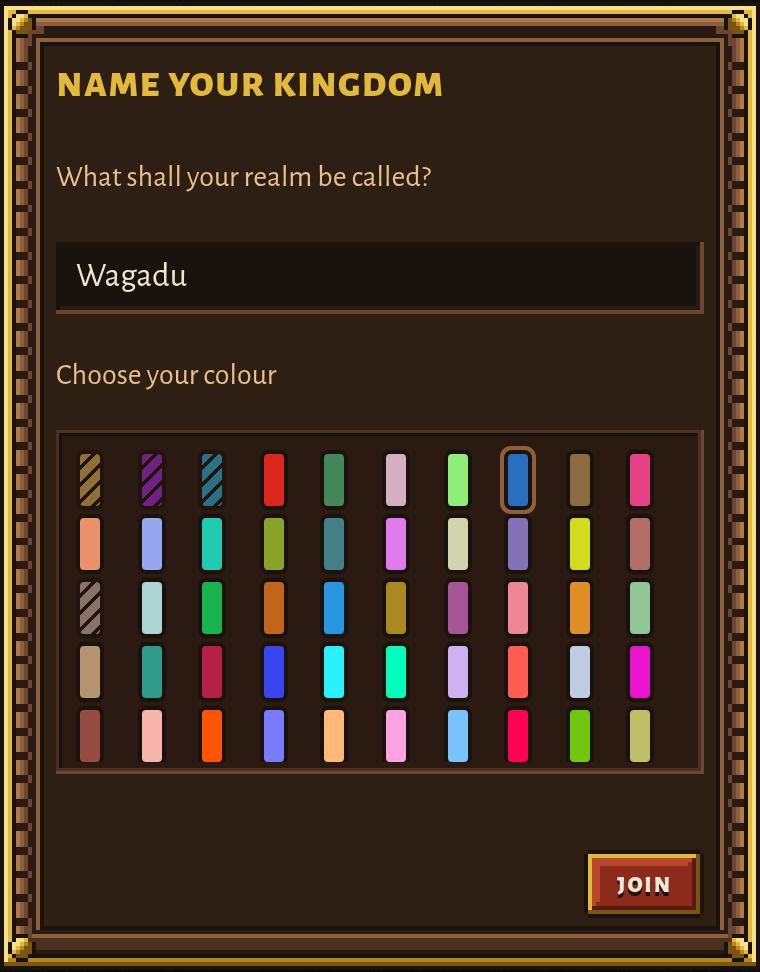
You sign in, you pick a world from a list, and the game asks you two questions: what your kingdom is called, and which colour it flies. That is the whole of it. You do not pick a starting position, a difficulty or a bonus.
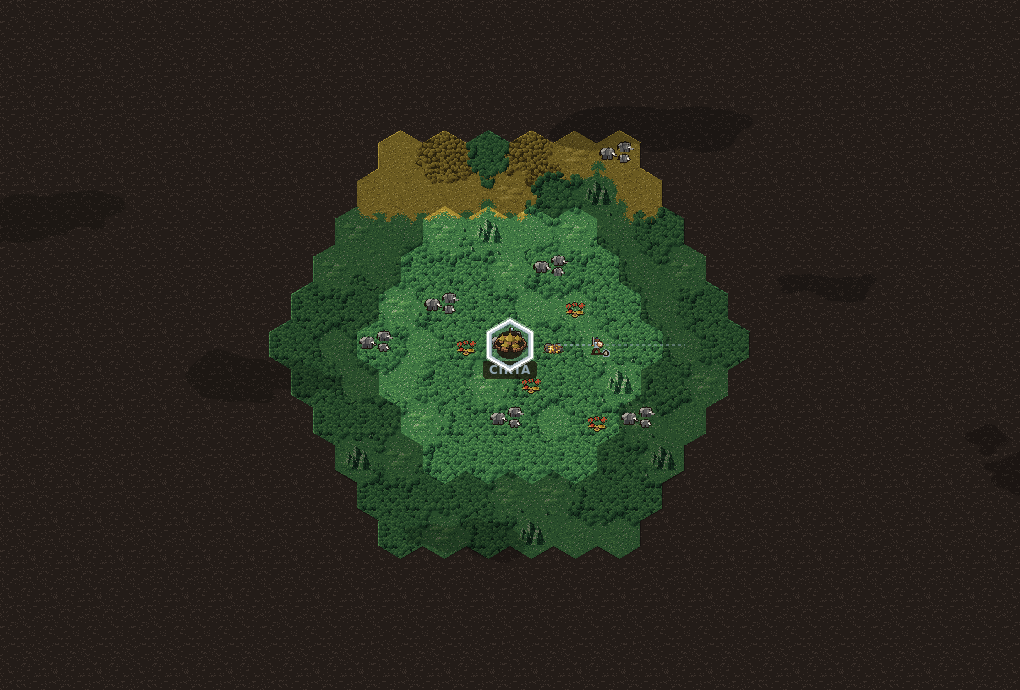
When you press Join, your answers go to the server and it does the founding for you. You will see the message "Waiting for the server to place your kingdom…" for a few seconds. What comes back is a capital city on a hex the server chose, a patch of revealed land around it, and fifty gold in your treasury.
So the founding decisions you genuinely control are small: a name, a colour, and which world you walked into. Everything after that is played, not chosen.
2Your name and your colour
The name box lets you type up to 32 characters, but only the first 24 are kept — anything past that is quietly trimmed when the kingdom is created. If a long name matters to you, count it out before you commit. Leave the box alone and you keep the name already in it.
Under the name is the colour grid: one hundred colours, and one kingdom to each. Colours already spoken for are greyed out and cannot be clicked; hover one and it tells you who has it. The game pre-selects the first free colour for you, so pressing Join without touching the grid is a perfectly good answer.
Two people can reach for the same swatch in the same moment. If you lose that race the join is refused and the prompt comes back with a line at the top — "That colour was just taken — pick another." Nothing else is lost; pick again and carry on.
Choose with the map in mind, not the swatch grid. Your colour is what every other ruler sees washed over your territory for the rest of that world's life, and you cannot change it afterwards. The first few dozen colours in the grid are the ones that stay furthest apart from each other on a crowded map.
3Who chooses where you land?
The server does, and it is not random. It looks at every unowned hex on the map and asks two questions in order.
First: how much is nearby? It counts how many of the three things that matter most — wood, stone and food — can be found on unclaimed land within three hexes of that spot. A hex with all three beats a hex with two, which beats a hex with one. Resources sitting on somebody else's land do not count, because you cannot dig them up.
Second, among the spots that tie: how far is it from everyone else? The winner is the hex furthest from the nearest tile anybody already owns. If a world is busy, you land in the emptiest corner of it that still has something worth digging.
That is good news and bad news in one. The good news is that you will never be founded on a barren square with a neighbour breathing down your neck. The bad news is that you start a long way from other people — and other people are who you trade with, learn from and swear alliances to. Expect your first hundred days to be lonely.
4What you are given on day one
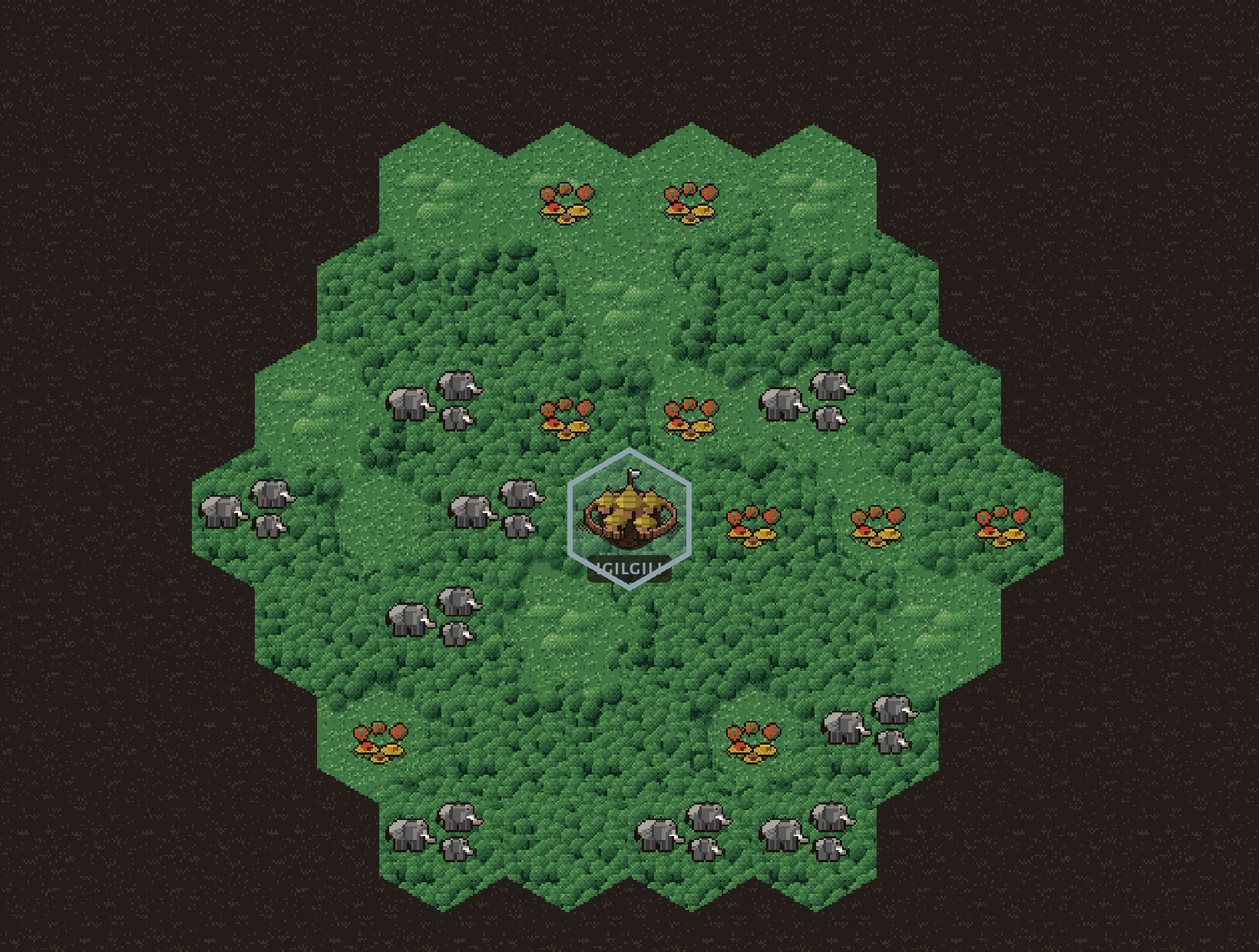
Your capital is not an empty field. It arrives with a working city already on it.
There are sixty-five people living there, and housing for a hundred. Fifteen of them are already at work on a farm — or a ranch, if your land has cattle — which was built and finished before you arrived. The other fifty are idle villagers standing around waiting for you to give them something to do. Four Storage Areas are already up, and the stores hold 50 wood, 50 stone and 50 of your local food.
The game also quietly guarantees that your capital is survivable. If the land you were placed on happened to have no food on it, a food that suits the climate is added — cattle in the Sahara and the Savanna, millet in the Sahel, grain in the Mediterranean and the Jungle. Wood and stone are added the same way if they were missing. So every capital can feed itself and build its first buildings, whatever the map rolled. Ordinary land you settle later gets no such favour.
Your city is also named for you, from a list of old African and Mediterranean city names — Meroe, Napata, Gao, Djenne, Axum and the rest. No two of your cities will ever share a name. You can rename it whenever you like.
5Reading the ground
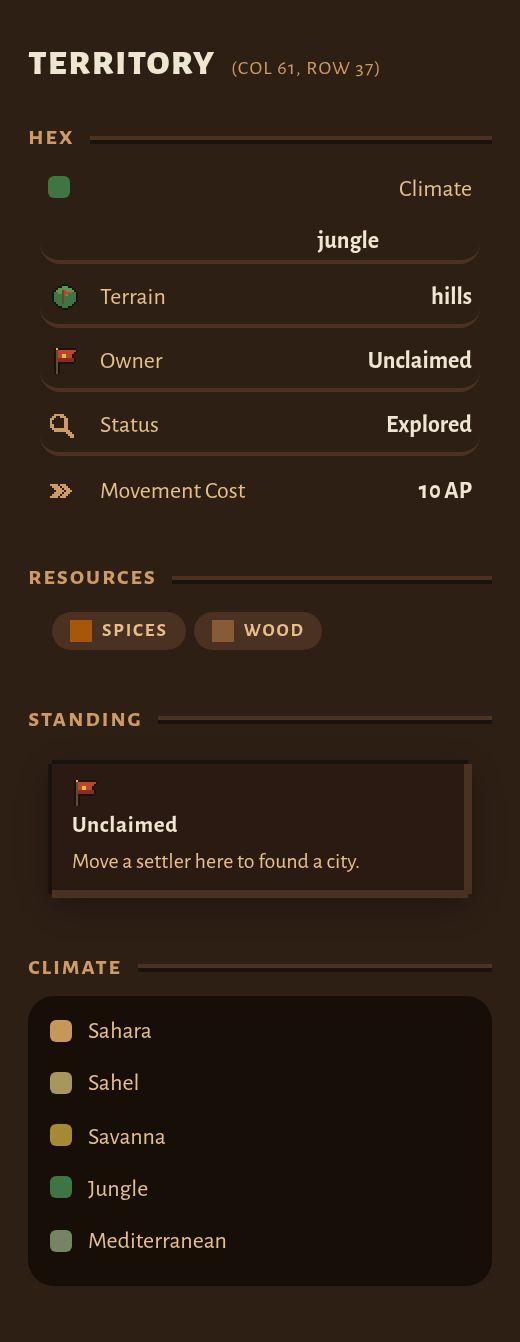
Click any hex and the Territory panel tells you four things: its climate, its terrain, who owns it, and whether you have explored it.
Climate is the wide band of country you are in, and it is what the map's base colour is showing you. The world runs from Sahara in the north, through Sahel, Savanna, Jungle, back to Savanna and then a Mediterranean south. Climate decides what kinds of things can be found there: gold, camels and salt in the Sahara; cattle, iron and millet in the Sahel; wood, ivory, spices and iron in the Jungle; cattle, iron, wood and ivory on the Savanna; stone, wood, gold and grain around the Mediterranean.
Terrain is the shape of the ground on that one hex — flatlands, hills, forest, desert or mountains. Here is the thing most new players get wrong, so it is worth saying plainly: terrain does not change what your land produces. A farm on hills and a farm on flatlands give you the same. What terrain changes is how hard the hex is to cross, how much a caravan loses going through it, and how hard it is to take in a fight.
| Terrain | Days to march in | Lost per caravan hop | Worth knowing |
|---|---|---|---|
| Flatlands | 1 | 2% | The cheapest ground to move goods and armies across |
| Forest | 1.5 | 4% | Defenders on it fight 20% harder |
| Hills | 2 | 5% | Defenders fight 25% harder; owning hills unlocks Terrace Farming |
| Desert | 2 | 7% | Slow and expensive to trade through |
| Mountains | 3 | 12% | The worst ground in the game to route anything over |
Read that table as a map of your future trade routes, not your future farms. A rich hex four hexes away over mountains is further from you than a poorer one six hexes away over flat country.
6Deposits are the thing that matters
Under the four rows in the Territory panel is a line of small chips. Those are the hex's deposits — the actual resources in that ground. This is the part of a hex that decides whether it is worth having.
A hex may carry several deposits, one, or none at all. An empty line reads None, and that is a real answer: plenty of land in this world simply has nothing in it. You cannot add a deposit to a hex, ever. What the ground holds is what it holds.
So when you look at land, look at the chips first and everything else second. Food deposits — grain, millet, cattle — are the ones that let a city stand on its own feet. Wood and stone are what every early building is made of. Iron, gold, salt, ivory, spices and camels are the things you will later sell, or need for a technology, and they tend to be scattered thinly on purpose so that no ruler can have all of them.
7The three shades of the map
The map shows land in three states, and telling them apart saves a lot of confusion.
Darkened ground is land you have never seen. It is not blacked out — the land is drawn and then washed over, so you can just make out the shape of the country beyond your border without learning anything useful about it. The Territory panel gives you ??? for its climate, its terrain and its deposits, and calls it Unexplored. You are not being hidden from — there is genuinely nothing to know yet.
Remembered land is land you saw once and cannot see now. Terrain and deposits stay on the panel, because ground does not move. Everything that can change is stripped out: no owner, no city name, no buildings, no armies. It is a note you wrote down, not a view.
Lit land is what you can see right now, live. You see that far around anything you own and around any army of yours: two hexes. A city with a finished Watchtower sees four. An army with a scout in it sees two further than it otherwise would.
Your very first view is wider than any of that: founding a capital reveals everything within three hexes of it. That ring shrinks to the normal two as soon as the game starts running. Nothing has gone wrong — you simply got a free first look.
If the panel shows terrain and deposits but the owner is blank, you are reading a memory. The deposits are still true. The ownership might be months out of date, and an army could be standing there right now. March carefully into land you are only remembering.
8What to look at before you build
Before you place a single building, spend two minutes doing this. Click your capital and read its deposits — that list is the ceiling on everything your first city can ever produce. Then click each hex in the ring around you and note which ones carry food, wood or stone, and what terrain sits between you and them.
You are answering one question: where does my second city go? Not today — you cannot afford it today — but knowing the answer shapes what you build first.
A hex is claimable when two things are true: you have explored it, and nobody owns it. That is all. There is no rule that your cities must touch, so you are free to leapfrog over poor ground to reach good ground. Be careful with that freedom, though — a city cut off from the rest of your kingdom has to be supplied across that gap, and a colony that cannot be supplied does not last. One more rule to remember: you cannot settle a hex while a foreign army is standing on it.
When you click land you could take, the panel says so directly: Unclaimed — move a settler here to found a city. That is the game telling you the only remaining obstacle is a settler party, which you have to muster on purpose.
If you take one thing from all this, take the order of the questions. Deposits first — they never change and you cannot add them. Terrain second, because it prices every march and every caravan you will ever run through that hex. Climate and everything else after. And now that you have a capital and know how to read the ground around it, go and read your first hundred days, which picks up exactly here and tells you what to do with those sixty-five people.