1What you are trying to do
Every day your people walk to the market and buy what they need with their own coin — food first, then a comfort or two if they can afford it. (On worlds created from ruleset 36 on, those comforts are only for sale where a market stall or market has a crew behind it.) You do not hand anything out. You are the ruler, not the shopkeeper.
So two quiet things decide whether your city thrives: whether your poorest families can afford to eat when grain is short, and whether the goods you are proud of are actually being kept, or wasting away in a shed that is already full. Caravans and neighbours are another guide. This one stays inside your walls.
2Why is grain cheap here and dear next door?
Each city sets its own prices every day from one question: how many days' worth of this do we have in store? About ten days' worth is normal, and normal means the ordinary price. Less than that and the price climbs — run nearly dry and it stops at four times the ordinary price. Pile up far more than ten days' worth and it falls, to a floor of a quarter of the ordinary price.
Wealth pushes on this too: a rich crowd bids prices up on the same shelf, a poor one barely moves them. Every city does this sum with its own shelf and its own people, so a full granary means cheap grain; a failed harvest next door means the same grain at four times the price.
| What is on the shelf | What your people pay |
|---|---|
| Almost nothing | up to 4× the ordinary price |
| About ten days' worth | the ordinary price |
| Far more than they can use | as low as ¼ of it |
3Where do I read all this?
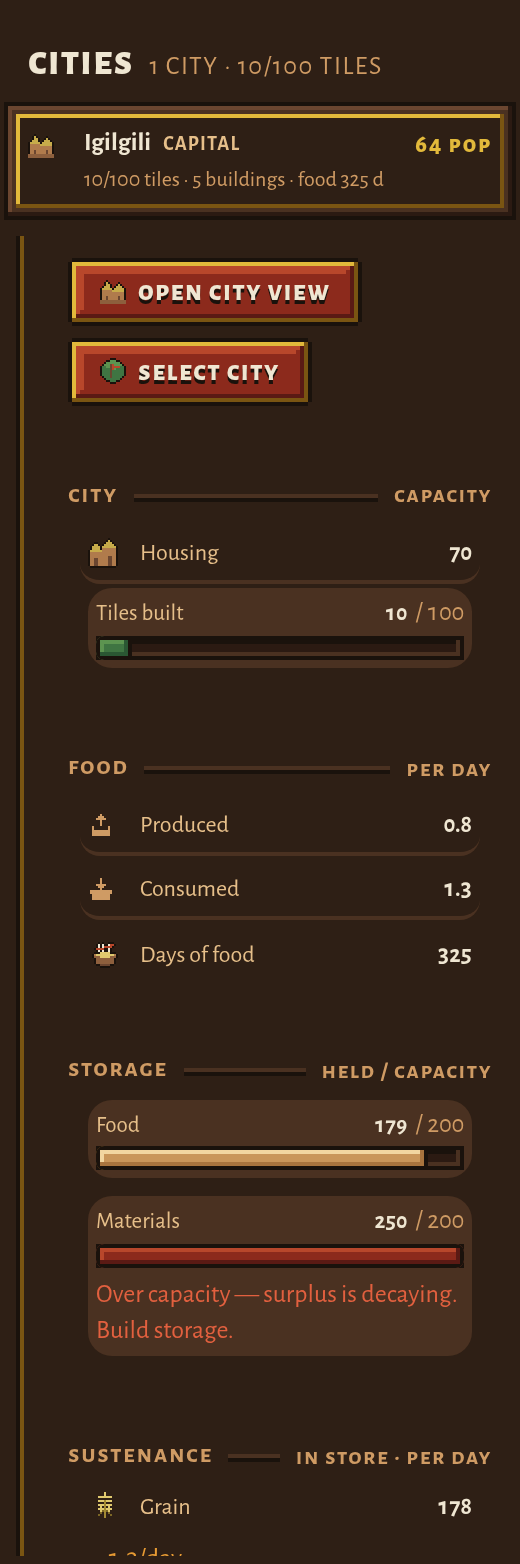
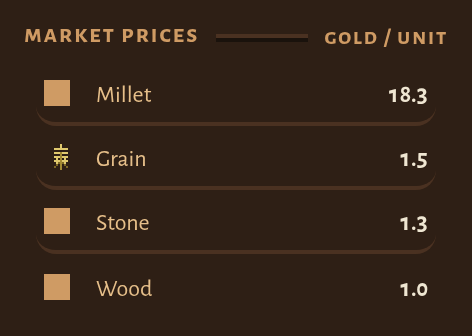
Open the City tab in the side panel with your capital selected. Just under the housing line you get food per day, the two storage bars, what is in store, then prices and how much coin each group of your people holds.
4Can I just make food cheaper?
Yes. Open the city view, go to its Market tab, and at the bottom is a block called Price ceilings — what your citizens pay. Type a number next to any good and that is the most your own people will ever pay for it.
The real price still exists underneath — it is what a foreign buyer pays. If it is already below your cap, nothing happens and the row shows a dash. When the cap is actually holding the price down it says binding, in green.
Now the important part. Someone has to cover the gap between the real price and the capped one, on every unit bought, and the dropdown asks who.
| Mode | Who pays the gap | What it costs you |
|---|---|---|
| treasury | Your treasury, every day; the sellers are paid in full | Gold, quietly, for as long as the cap holds |
| decree | Nobody. The sellers simply get less | No gold — but less coin flows back to your people tomorrow |
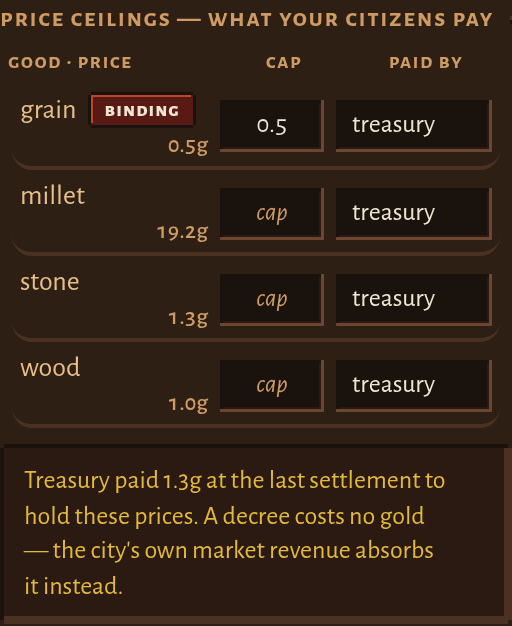
So a ceiling is a quiet drain, and it is easy to forget it is on. Why bother? Because when grain is short its price climbs, and the families with the least coin go without first — not because the grain is gone, but because they cannot afford what is left. Cap the price and they can eat. For a hungry city in a bad week, that is worth a great deal of gold.
A ceiling is a bandage, not a policy. Set it when the price spikes, watch the gold line, and clear the box the moment the shelf recovers. A cap left on a cheap good does nothing — and it hides the day the price quietly climbs back.
5What does "Unfunded" mean?
Each day, after everyone has shopped, the city adds up what the treasury owes for the caps it held. If the treasury cannot cover the whole bill, it pays none of it. Your people still got their cheap grain — the promise held — but the sellers were not made whole, exactly as if you had chosen decree. A red line appears under the block and a bell rings.
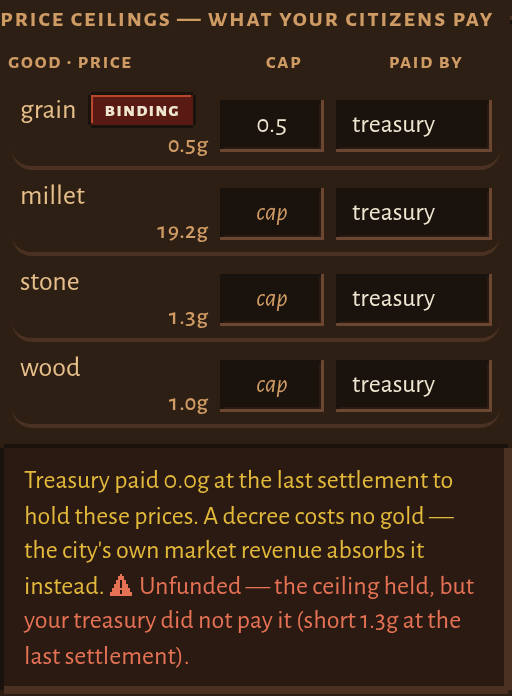
It is checked fresh every day. Top the treasury up and tomorrow's bill is paid normally.
6Why is my grain rotting?
Because your store is full. The rule is kinder than most people assume: nothing in store goes bad as long as it fits. Only what spills over the line is lost.
Every capital starts with four Storage Areas, each holding fifty of anything. There are two separate shelves, and both use those same buildings: one for food, one for everything else. So a new city keeps 200 of food and, separately, 200 of wood, stone and the rest. Wood never crowds out your grain, but grain, millet and cattle share one shelf.
Go over the line on either shelf and the overflow wastes. A quarter of whatever is over the line is lost each day, taken from every good on that shelf in proportion to how much of each you hold. It never eats below the line. Put a hundred over and, a week later, about thirteen of that hundred are left.
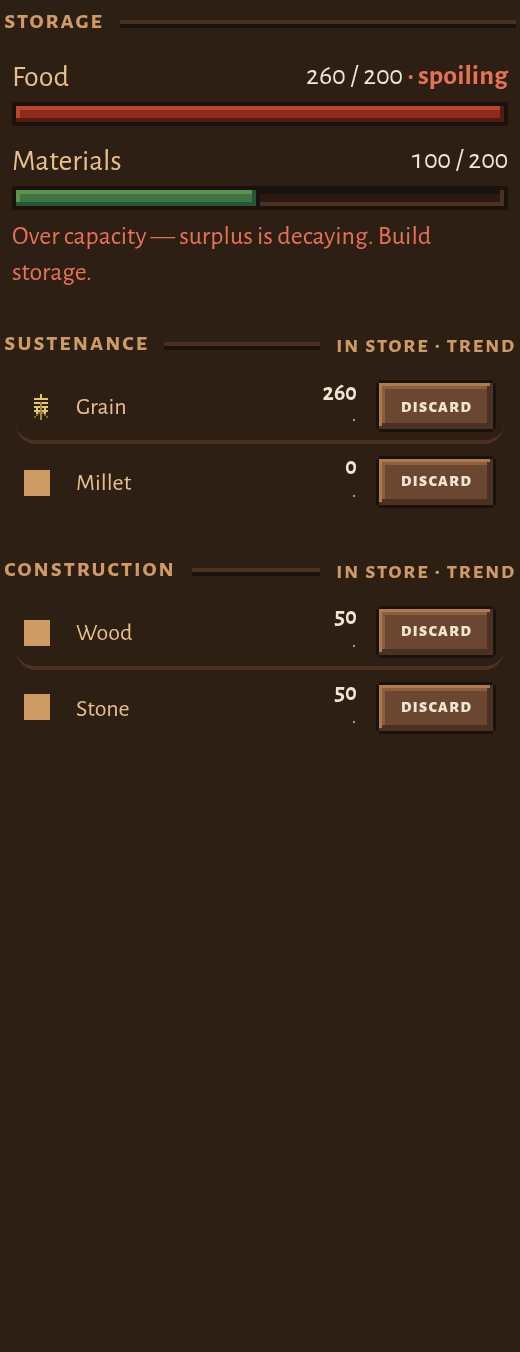
Three ways to push the line up. Build more storage: a Granary adds a hundred to the food shelf only, and once you know Warehousing each Storage Area can become a Warehouse holding a hundred and fifty. Drystone Silos makes every store about a sixth bigger. And Salt Curing, an Iron Age discovery, slows the rot itself: a bit under a fifth of the overflow a day instead of a quarter, so a hundred over the line leaves about twenty-five after a week instead of thirteen.
"Spoiling" makes people think of grain, but the materials shelf wastes at exactly the same rate. A logging camp with nowhere to put its wood is burning a quarter of its surplus every day. If a bar is red, something is being lost.
7What should I throw away?
Because the loss is shared across the shelf, an overflowing store takes a slice of everything on it, not just the thing you have too much of. Forty spare cattle on a full food shelf are costing you grain.
That is what Discard is for, on the city view's Stockpile tab, one button per good. Pick a whole number, confirm, and it is gone — no refund, nothing else changes. It feels wasteful; it is the opposite. Forty of something you cannot sell is worth nothing to you, and dumping it is the cheapest way to save the food beside it.
Before you throw anything away, ask whether someone else wants it. A glut is a low price at home, and a low price at home is a good price to sell abroad. Your own people will not clear it for you. They never spend more than half their spare coin a day, and on worlds created from ruleset 36 on they can only buy as many comforts as your crewed stalls and markets can sell. From ruleset 38 on they buy a little of every comfort on sale, and only as much of each as they want, so a pile of one comfort mostly stays put. The luxuries guide has the details. Sell the rest or discard it.
If you want one plan out of all this: watch the two storage bars before anything else, and treat red as a loss you are taking today. Build a granary early, keep the shelves under the line, and throw away what you cannot sell rather than let it rot the food beside it. Save the price ceiling for a hungry week — cap food, pay the gold, and take the cap off when the shelf is full again.